Website as a service (WaaS) means you pay a provider monthly for a website that they build, host and maintain, instead of paying for a full build up front. It can be a good deal for a small business that wants a predictable budget and someone else handling the technical work. It turns into a bad deal when the contract bundles everything into one vague fee and the provider owns the site, the hosting and the domain. This guide covers how the model works, what to compare, and how we handle it at Red Rock Webscapes.
Key takeaways
- WaaS swaps a large one-time build bill for a smaller setup cost and a monthly fee, so the real comparison is total cost over two to three years, not the first invoice.
- The biggest risk is a bundled, auto-renewing fee with vague “general support” and hosting in the provider’s account, not yours.
- Ask for a written list of maintenance tasks, ownership of your domain and content, and a clear exit path before you sign.
- Be skeptical of any provider that promises “instant” AI-driven results, especially on accessibility.
- Our Website Launchpad pairs a $99 or $150 setup fee with care plans from $79 per month.
Table of Contents
- What website as a service actually means
- Why small businesses are drawn to it
- What website as a service costs
- The traps that matter
- A checklist before you sign
- AI claims and accessibility
- Who it fits, and who should skip it
- Our perspective
- Start with the Website Launchpad
- FAQ
- Sources
What website as a service actually means
The idea borrows from software as a service. You do not buy a website outright and then figure out how to keep it running. You subscribe, and the provider treats the site as an ongoing product.
Definitions vary by provider. Cloudways describes it as renting a website rather than building one from scratch. Some agencies spread the cost of a custom build over a fixed term, such as 24 months. Others sell template-based sites with hosting and updates included. Others, like us, split the arrangement in two: a project fee to build, then an optional monthly plan to care for the site.
That difference matters more than the label. “Website subscription” can mean three quite different things:
| Model | What you pay | What you own | Typical catch |
|---|---|---|---|
| Financed custom build | Monthly payments over a fixed term | Often the site, after the term | Early exit may cost the remaining balance |
| Templated all-in subscription | One monthly fee, little or no setup | Usually nothing; you rent | Leaving means starting over |
| Build fee plus care plan | One-time build, then monthly care | The site, domain and content | You must price maintenance separately |
When someone quotes you a monthly price, the first question is which row they are in.
Why small businesses are drawn to it
The appeal is simple. A custom site can cost thousands of dollars before a single customer sees it, and a small business owner would rather spend that cash on inventory, rent or ads. A monthly model smooths the cost. It also removes a chore: someone else watches for outages, applies updates and fixes broken pages.
There is a real demand behind this. A 2025 survey of 1,500 U.S. small and medium-sized businesses that sell goods online found that 99% consider digital tools and technologies essential. For those owners the website is not a brochure. It is a sales channel that has to stay fast, secure and current.
What website as a service costs
Prices vary widely and many providers do not publish them. Here is what we can say with certainty: ours.
Our published numbers
Our Website Launchpad program is built around a low upfront cost and a separate care plan:
- Setup fee: $99 one-off for a standard business build, $150 one-off for an e-commerce store build.
- Managed Core: $79 per month.
- Growth Care: $149 per month.
- Commerce Care: $199 per month.
If you would rather pay for a build in full, our packages include Commerce from $2,000 one-off and Signature from $2,500 one-off. E-commerce projects on our store design page start at $2,500 for Brick & Mortar, $3,500 for E-Tail and $4,000 for Dropshipping, all one-off. Business email is $29 per month.
The scope behind each figure is on those pages. We price custom work by project need, so a quote is where the final number comes from.
How to compare over time
Do not compare a monthly fee with a one-time fee directly. Add up the full cost over 36 months.
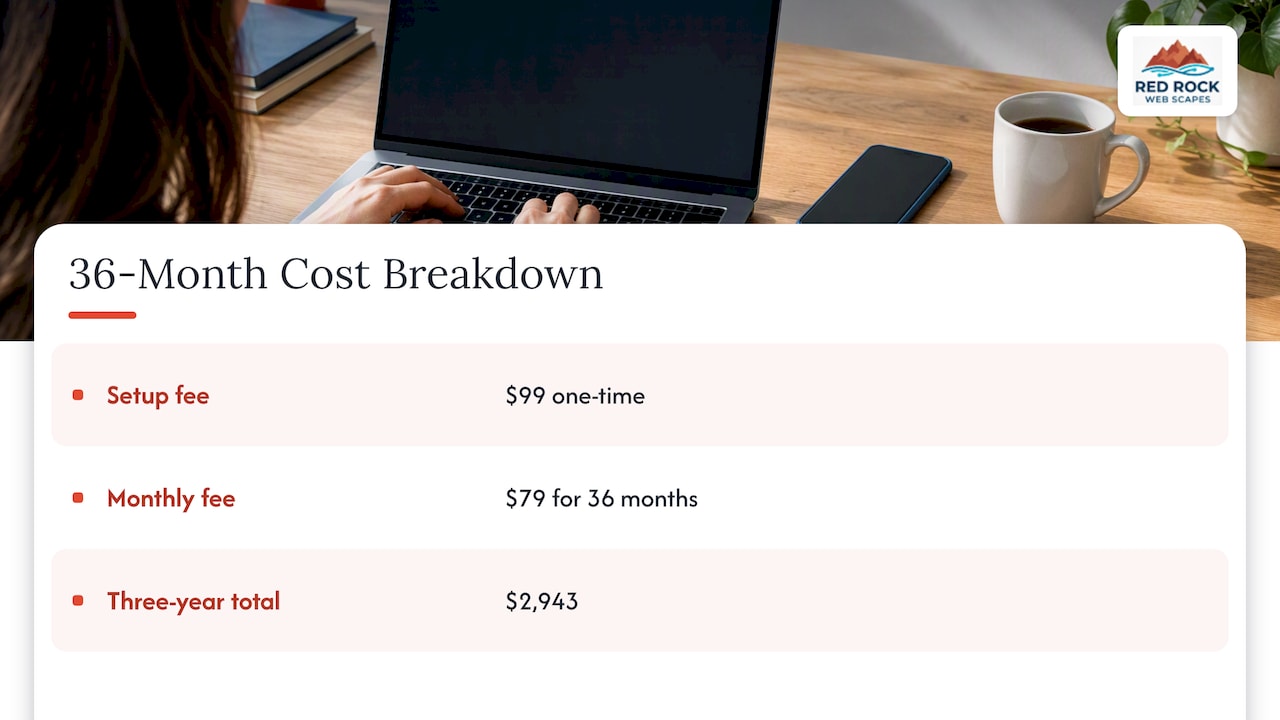
A simple worked example using our published figures: a standard Launchpad build with the Managed Core plan costs $99 plus $79 times 36 months, which is $2,943 over three years. The same arithmetic on any competitor’s quote takes two minutes, and it shows what you pay for the convenience. It also shows what happens to that cost if you cancel in month 14.
Then ask what the monthly fee covers. If a plan includes hosting, security updates, backups and a few hours of changes, the fee may be fair. If it only says “support,” it is not a price you can evaluate.
For a wider look at budgets and what to ask a vendor, see our guide to small business website costs.
The traps that matter
The strongest criticisms of WaaS are worth taking seriously. Some agencies argue the model produces generic packages and templated sites that do not fit a client’s goals, and that it is too easy to buy without thinking it through. Those arguments describe a real risk, not an inevitable outcome. Here is what to check.
Bundled fees and hosting in someone else’s name
The most damaging pattern is a single auto-renewing fee that rolls hosting, maintenance and support together. Contract guidance for small organizations recommends keeping these separate, naming specific tasks such as monitoring, backups and updates instead of a loose promise of general support.
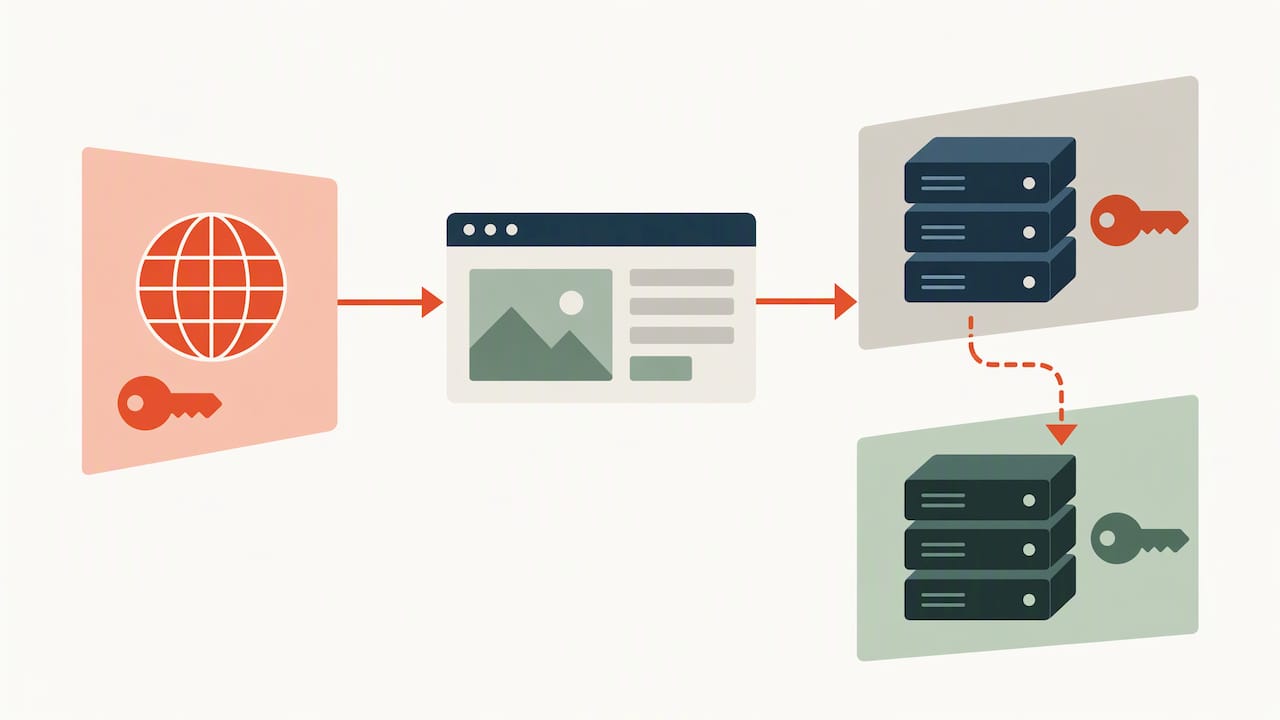
The same guidance flags whose name the hosting account is in. If the provider insists on hosting in its own account, you are effectively renting your own web presence, and you could lose it if the provider closes. The practical fix: hold the domain registration in your own name, and ask whether the hosting account can be yours or can be transferred to you.
Templated sites you cannot leave
If the site runs on a proprietary platform, the monthly fee is the price of keeping the lights on. Ask directly: if I cancel, do I get the code, the content, the images and the domain? Get the answer in the contract, not on a sales call.
Early-stage cash and long terms
A 24- or 36-month term with an early termination fee is a loan under another name. That is fine if you know it. Ask what happens if you want to move on after a year, and whether the provider will refund unused prepaid months.
Rigid deliverables
Packages define what you get, and your business may need something different. Ask how a change in scope is priced, and whether you can add a feature later without renegotiating the whole agreement.
A checklist before you sign
- Total cost over 36 months, including setup, monthly fees and any renewal increases.
- Ownership: domain, hosting account, content, code and design files.
- A named list of maintenance tasks, such as uptime monitoring, backups, security patches and plugin updates.
- Response times for urgent problems, in writing.
- Change requests: how many are included, and what extra ones cost.
- Exit terms: notice period, handover files, and any fees to leave.
- Who pays for third-party tools, such as a theme license, a plugin or an email service.
- What happens on provider failure: can you reach the hosting account without them?
Our guide to website maintenance plans walks through a 30-minute audit you can run on any provider’s tiers.
AI claims and accessibility
More WaaS providers now advertise AI that builds and manages your site. AI can speed up development. It cannot certify that your site works for everyone.
In January 2025 the FTC required accessiBe to pay $1 million to settle allegations that it misrepresented its AI tool’s ability to make any website compliant with the Web Content Accessibility Guidelines. The lesson for a business owner is plain: no automated tool makes a site compliant by itself. The Department of Justice’s web accessibility guidance addresses how businesses open to the public should make their sites accessible to people with disabilities under the Americans with Disabilities Act.
If a provider promises “instant compliance” for a monthly fee, ask what manual testing it does and how it handles alt text, form labels and keyboard navigation. We explain our approach in AI-assisted web development.
Who it fits, and who should skip it
A subscription-style arrangement tends to suit you if:
- You are launching a store or service business and want cash left for inventory and marketing.
- You have no one in-house to handle updates, backups and security.
- You want one accountable contact rather than juggling a freelancer, a host and a plugin vendor.
It tends to fit poorly if:
- You have a developer on staff who can maintain the site cheaply.
- You need heavy custom functionality that a package cannot support.
- You are not willing to read the exit terms.
Selling across channels
Mobile and multichannel selling raise the bar for any site. The same 2025 survey found that 70% of small online sellers use multiple sales methods, such as web stores, marketplaces and physical storefronts. Visa Acceptance’s U.S. report found that nearly two-thirds of online shoppers used a phone for their most recent online purchase. A subscription site therefore has to be responsive and quick at checkout, and it should connect to the other places you sell. If you are weighing options for a store, ecommerce development agency profiles can help you compare how different teams approach this.
Once a store is live, conversion work pays off. Our guides on raising your ecommerce conversion rate and ecommerce SEO for small stores cover the first fixes.
Our perspective
We built the Website Launchpad because we saw the same problem again and again: a good owner with a good business, and no spare four figures for a website. We also saw what the all-in rental model does to people who later want out.
So we separate the two things. The build has a clear setup fee, $99 for a standard business site or $150 for a store. The care is a distinct plan, with published monthly prices of $79, $149 or $199 depending on what the site needs. You can see what you are paying for each part, and that makes comparing us to anyone else straightforward.
We combine traditional agency design with AI-assisted development, which shortens build time. We do not use it as a stand-in for judgment, and we would not tell you any tool makes a site accessible on its own. We are local to Las Vegas, we explain our process in plain terms, and we stay available after launch.
Our advice, whichever provider you choose: read the exit clause first.
— George
Start with the Website Launchpad
If you want a custom site without a large upfront bill, the Website Launchpad is where to begin. You pay a $99 setup fee for a standard business build or $150 for an e-commerce store, then choose a care plan: Managed Core at $79 per month, Growth Care at $149 per month, or Commerce Care at $199 per month. If you prefer a full project price, see our packages or the e-commerce options. Not sure which fits? Ask for a quote from our home page.
FAQ
What is website as a service?
It is a model where a provider builds, hosts and maintains your website for a recurring fee rather than a large one-time payment. Some versions rent you a template site; others finance a custom build over a set term. Check the contract to see which one you are getting.
How much does a website subscription cost?
It depends on scope and on what the fee includes. Our Launchpad care plans are $79, $149 and $199 per month, plus a $99 or $150 one-time setup fee. Compare any quote by adding setup and monthly fees over 36 months.
Do I own my website under a subscription?
Only if the contract says so. Ask in writing about the domain, hosting account, content and code, and whether you receive them if you cancel. Keep the domain registered in your own name.
Is a website subscription better than a one-time build?
Neither wins in every case. A subscription spreads cost and bundles upkeep, while a one-time build usually costs less over several years if you can maintain the site yourself or buy care separately. Run the 36-month math on both.
Sources
- Contracts for maintenance and hosting: the clauses that matter, CivSec S.M.A.R.T
- SUPER SELLING: Retail Choices and Competition, Data Catalyst
- FTC order on accessiBe, Federal Trade Commission
- Guidance on Web Accessibility and the ADA, ADA.gov
- The 2025 Global Digital Shopping Index: U.S. Edition, Visa Acceptance
- Website as a Service, Cloudways
- Ecommerce Development SA, Agency Review Guide