For most small online sellers, TaxJar is the simpler and cheaper start, and Avalara is the better pick once your tax picture gets complicated: many states, exemption certificates, ERP software, or international sales. Both calculate sales tax at checkout, watch your nexus, and can file returns. They differ in price structure, how much setup they need, and how far they reach beyond U.S. sales tax.
This guide compares them on the points that decide the choice, then gives you a short checklist to run before you sign anything.
Key takeaways
- TaxJar publishes plans from $39 a month and is built around U.S. sales tax for e-commerce sellers. Filing is billed separately per return.
- Avalara prices by state ($79 per state per month on Core Compliance, three-state minimum) and covers more: use tax, exemption certificates, registrations and global compliance.
- If you sell mainly through Shopify, WooCommerce, Amazon or BigCommerce in a handful of states, TaxJar usually fits. If you run an ERP or have complex needs, look at Avalara first.
- Neither tool replaces a decision about where you have nexus. Check your state thresholds and talk to a CPA before you register or file.
- Your store setup matters: tax software is only as accurate as the product, shipping and address data your checkout sends it.
Table of Contents
- What each tool actually does
- Pricing: the biggest practical difference
- Calculation, nexus and filing
- Integrations and ecosystem
- Setup and ease of use
- Which one fits which business
- What to check before you buy
- Perspective: the store has to feed the tax tool
- Building the store that connects to either tool
- FAQ
- Sources
What each tool actually does
Both products automate U.S. sales tax compliance, including calculation and filing support. Avalara’s own comparison says Avalara offers broader compliance coverage while TaxJar focuses on U.S. sales tax for e-commerce sellers. That is a vendor’s framing, but an independent review lines up with it: ERP Research describes Avalara as a cloud solution for small business through enterprise, and TaxJar as a cloud solution for small and mid-market businesses with e-commerce and marketplace connectors.
Avalara presents an end-to-end platform with real-time calculation across 12,000+ U.S. jurisdictions, nexus monitoring and filing. It also handles use tax, exemption certificate management and global compliance.
TaxJar describes one platform for checkout calculation, nexus monitoring, reporting, filing and remittance. Its feature list includes prebuilt e-commerce and ERP integrations, rooftop-level calculation, Nexus Insights, and AutoFile for filing and remittance. It also claims an average calculation response under 20 milliseconds.
Pricing: the biggest practical difference
The two companies price in completely different ways, which makes a quick comparison misleading. Here are the published numbers.
| TaxJar | Avalara (Select) | |
|---|---|---|
| Entry price | Starter from $39/month | Core Compliance $79 per state per month |
| Annual option | Annual billing at 10% or more off | $799 per state per year |
| Next tier | Professional from $99/month | Core Compliance + SST Services $69 per state per month ($699 per year) |
| Minimums | None stated | 3 states on Core Compliance; none on SST Services plan |
| Filing | Billed separately: $50 per filing (Starter), $55 (Professional) | Unlimited returns included, no per-return fees |
Sources: TaxJar pricing and Avalara’s U.S. pricing page.
What TaxJar costs once you file
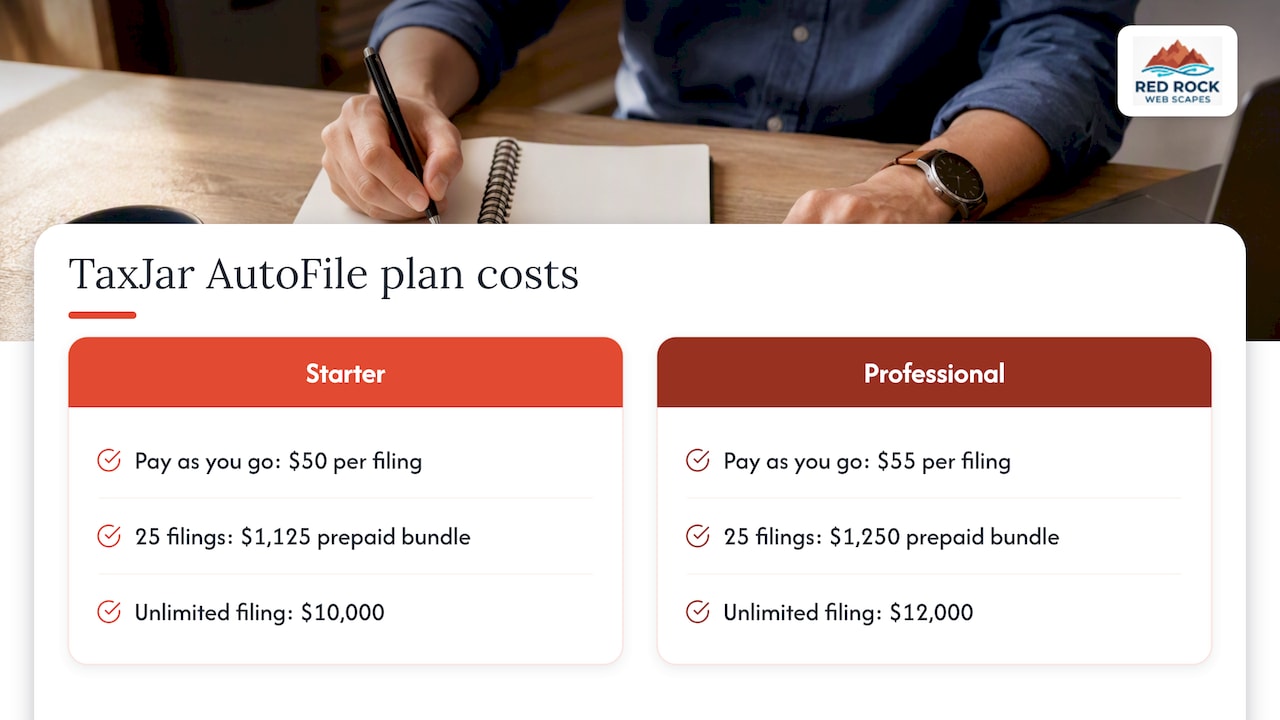
TaxJar’s headline price covers calculation, nexus monitoring and reporting. AutoFile is charged separately from the subscription: $50 per filing on Starter and $55 on Professional when you pay as you go. Prepaid annual bundles exist, such as 25 filings for $1,125 on Starter or $1,250 on Professional, and unlimited filing is $10,000 on Starter or $12,000 on Professional (page updated February 26, 2026).
A worked example makes the gap clear. Say you register in four states that all require monthly returns. That is 48 filings a year. On Starter at $50 each, filing alone is $2,400 a year, before the subscription. A quarterly filer in the same four states makes 16 filings, so $800 a year. Filing frequency is set by each state, so check it before you budget. TaxJar also charges $299 per state to register for sales tax permits on your behalf.
If you want a plain-English walk through of how automated return filing costs flow into a small seller’s books, this side hustle tax checklist is a handy companion for sole proprietors just crossing the line from hobby to business.
What Avalara costs when you grow
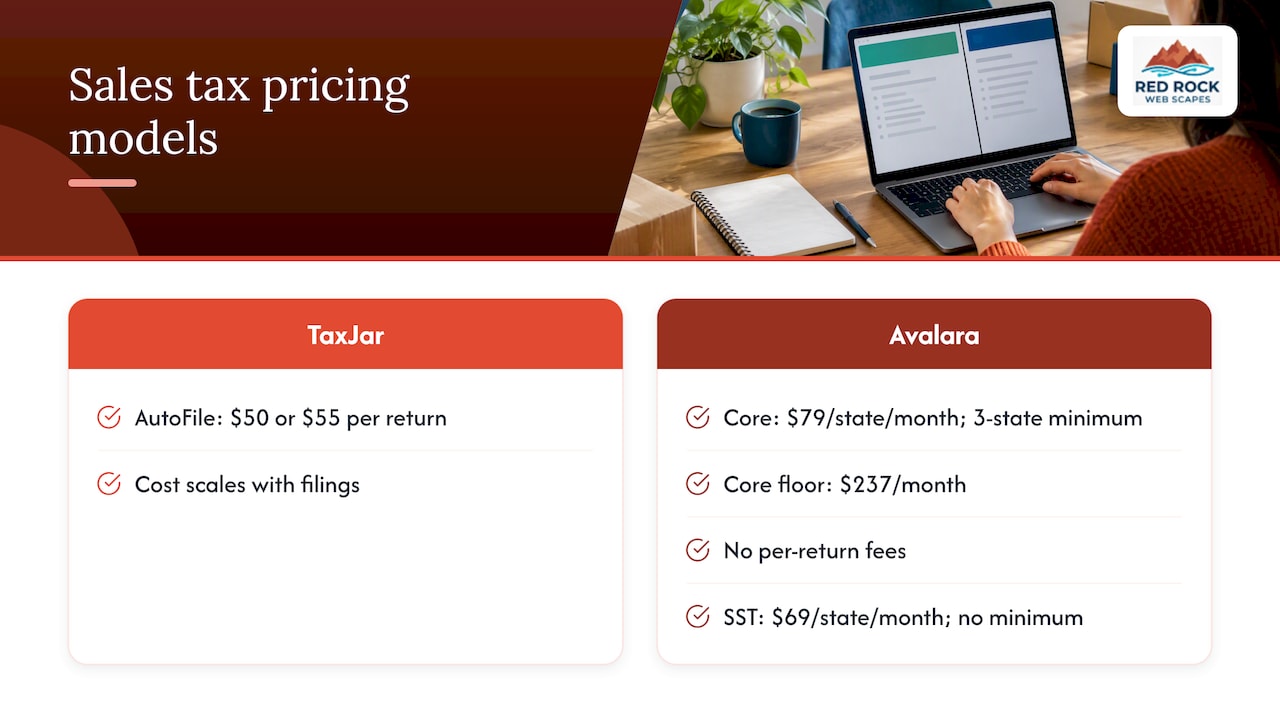
Avalara’s Select plans include calculation, unlimited returns and nexus monitoring with no per-return fees, per its pricing page. The catch is the per-state structure. Core Compliance at $79 per state per month has a three-state minimum, so the floor is $237 a month, or $2,397 a year on annual billing. The SST Services plan, at $69 per state per month, has no state minimum and provides state-funded calculation and filing in up to 25 states for qualifying sellers.
So a seller in one or two states may pay less on TaxJar, while a seller filing monthly in many states can come out ahead on Avalara’s no-per-return structure. Run your own numbers: states times filings per year times $50 or $55, against states times $69 or $79 times 12.
Calculation, nexus and filing
Both tools calculate at the rooftop level and both track economic nexus. Avalara says its rooftop geolocation, sourcing logic and tax content help it handle state and local rules, including self-administered localities. ERP Research’s assessment is that both platforms offer real-time calculation and economic nexus tracking, while Avalara has stronger evidenced coverage across the wider set of compliance capabilities.
Nexus: the part software cannot decide for you
Since the Supreme Court’s Wayfair decision, states can require out-of-state sellers to collect tax once they pass a sales or transaction threshold. TaxJar’s state guide lists thresholds ranging from $10,000 to $500,000, and for Nevada it lists $100,000 in gross revenue or 200 or more separate transactions. Both tools alert you as you approach a threshold. You still decide when to register, and physical presence (inventory, employees, a warehouse) can create nexus regardless of sales volume. A CPA who knows multistate sales tax is the right person to confirm that.
Filing coverage
TaxJar’s AutoFile supports state returns in every state except Alaska and does not file outside the U.S. Avalara offers managed returns and notice handling, and its comparison page highlights business licensing and registrations, tax research and Streamlined Sales Tax support. If you need help responding to a state notice, that service difference counts.
Integrations and ecosystem
Avalara says it has 1,400+ signed integrations across ERPs, marketplaces, POS platforms and e-invoicing tools, and that TaxJar offers roughly 100 and lacks direct connectors for NetSuite, Sage 50 and several other ERPs. Treat that as Avalara’s claim about a rival. TaxJar, for its part, lists native integrations with Shopify, Amazon, Walmart, BigCommerce and WooCommerce, plus QuickBooks on the accounting side.
For a typical small store on one of those platforms, TaxJar’s smaller list is not a limitation. It becomes one when your stack includes an ERP or a point-of-sale system that only Avalara connects to.
Setup and ease of use
By common account, TaxJar is quicker to start. You can sign up, connect your store and see numbers the same day. Avalara needs more configuration, and its pricing is more of a conversation once you move past Select, which is one reason small sellers on forums describe it as heavy. Avalara also rewards the setup effort: if you have exemption certificates, multiple entities or non-sales taxes, the extra configuration is what makes the tool useful.
Which one fits which business
| Your situation | Likely fit |
|---|---|
| One online store, a few states, want self-service setup | TaxJar |
| Shopify, WooCommerce or Amazon seller with low filing volume | TaxJar |
| Many states with monthly filing and heavy return volume | Avalara, after you do the math |
| ERP, POS or niche platform connectors needed | Avalara |
| Wholesale with exemption certificates or use tax | Avalara |
| International VAT or global obligations | Avalara |
Other tools exist too. Stripe Tax and several filing-focused services compete in this space, so if neither of these fits your numbers, get one more quote before you commit.
What to check before you buy
This is the part most comparison pages skip. Before you pay for either tool:
- List where you have nexus. Add up sales and transaction counts per state for the current and prior year, and note where you hold inventory or staff.
- Confirm your filing frequency. States assign monthly, quarterly or annual filing. It drives TaxJar’s per-filing cost directly.
- Map your stack. Write down your cart, marketplace, accounting and shipping tools, then check each has a connector.
- Check product taxability. Clothing, food, digital goods and shipping charges are taxed differently by state. Make sure your catalog carries the right tax categories.
- Ask who handles notices. If a state sends a letter, know whether the vendor, your CPA or you respond.
- Model year-two cost. Add the states you expect to cross in twelve months, not just today.
If you run payroll too, remember that sales tax and employment tax are separate compliance tracks with separate deadlines. This overview of employment tax for employers shows how that second track works, which helps when you’re sizing your total compliance workload.
Perspective: the store has to feed the tax tool
We build online stores for small businesses, and we see the same pattern. Sellers spend weeks comparing tax software and then connect it to a store whose product data is messy: missing tax categories, shipping set up as one flat fee, addresses collected without validation. The software then calculates exactly what it was told to. The comparison matters, but the setup underneath it decides whether your tax numbers are right.
Our advice is to pick the tool before the build, not after. Tell your developer which platform you’re using and which tax tool you plan to connect, so product categories, shipping lines and checkout address fields are built to match. It’s far cheaper than reworking a live catalog. Our ecommerce launch checklist covers the rest of what to have in place before going live, and our shipping strategy guide explains why how you charge for shipping touches tax as well.
We are not tax advisors, and we don’t sell tax software. Your CPA owns the nexus and filing decisions. What we own is making sure the store hands them clean data.
— George
Building the store that connects to either tool
If you’re launching a store and want the tax connection planned in from day one, our e-commerce web design services start with Brick & Mortar from $2,500, E-Tail from $3,500 and Dropshipping from $4,000 one-off. Our Website Launchpad program is the low-upfront route: an e-commerce store build setup fee of $150 one-off, with Commerce Care managed support at $199 per month. Both are published prices; see the pages for what each includes.
FAQ
Does TaxJar file sales tax returns for you?
Yes, through AutoFile, which is sold separately from the subscription. It supports every state except Alaska, and costs $50 per filing on Starter or $55 on Professional if you pay as you go. Prepaid bundles lower the per-filing cost at higher volume.
Is Avalara more expensive than TaxJar?
Not always. Avalara’s Core Compliance starts at $79 per state per month with a three-state minimum, but includes unlimited returns with no per-return fees. For a seller in one or two states TaxJar is usually cheaper, and for one filing monthly in many states Avalara can be.
Which is better for a Shopify or WooCommerce store?
TaxJar lists native integrations with both and is built for e-commerce sellers, so it is the common starting point. Avalara also connects to major platforms, so check the specific connector and plan before choosing.
When do I need to collect sales tax in another state?
When you cross that state’s economic nexus threshold or have a physical presence there. Thresholds vary by state; Nevada’s is $100,000 in revenue or 200 transactions. Confirm your obligations with a CPA before registering.
Sources
- TaxJar vs. Avalara, Avalara
- Avalara tax compliance software
- Avalara sales tax plans and pricing
- Avalara vs TaxJar, ERP Research
- TaxJar platform
- TaxJar pricing
- How much does AutoFile cost? TaxJar Support
- How does AutoFile work? TaxJar Support
- 2026 sales tax software comparison, TaxJar
- TaxJar vs. Numeral, TaxJar
- Economic nexus laws by state, TaxJar