A good ecommerce shipping strategy answers four questions before your store goes live: what will you charge customers, which carrier and rate program will you use, how will you handle returns, and how will you tell shoppers all of it at checkout. Get those right and shipping becomes part of your conversion funnel instead of a margin leak. Get them wrong and shoppers leave at the last step. DHL’s 2025 U.S. e-commerce report found that 76% of U.S. shoppers abandon carts when their preferred delivery option is missing.
This guide is written for small store owners and founders. It walks through the decisions in the order you should make them, with real carrier programs, worked numbers and the checkout settings that put them into practice.
Key takeaways
- Decide your shipping model from your margins first, then design the checkout around it. Free shipping is a pricing decision, not a marketing gimmick.
- Small businesses do not need huge volume for decent rates. USPS Connect eCommerce and UPS Small Business Rates exist for exactly this.
- Shoppers value a reliable delivery promise over raw speed. Show a delivery window you can keep.
- Your shipping and returns policy is a conversion page. Write it in plain language and link it from the cart.
- Build label printing and tracking into the store at launch, not six months later.
Table of Contents
- Why shipping is a conversion problem first
- Step 1: Know your real cost to ship
- Step 2: Choose a shipping model
- Step 3: Pick carriers and use small-business rate programs
- Step 4: Set delivery promises you can keep
- Step 5: Write a shipping and returns policy shoppers actually read
- Step 6: Set it up in your store
- Our perspective
- Getting the store built to match
- FAQ
- Sources
Why shipping is a conversion problem first
Most shipping advice starts with carriers. Start with the shopper instead. McKinsey’s survey of more than 1,000 U.S. consumers points to a few patterns that should shape your whole setup:
- Shoppers abandon carts when shipping costs feel high. The same research reports that a large majority are willing to wait several days if delivery is free.
- Reliability beats speed. People accept a slower promised window, but treat an order as late once it misses the expected date by a day or two.
- Returns matter before purchase. Restrictive policies, such as final sale only, make many shoppers leave.
The practical lesson: you do not need to match Amazon’s speed. You need to be clear, consistent and fair on cost. A small shop that says “ships in 1 business day, arrives in 3 to 5” and delivers exactly that usually beats a shop promising two days and slipping.
Step 1: Know your real cost to ship
You cannot choose between free shipping and flat rate until you know what an average order costs you to send. Build a simple sheet with these columns for your top ten products:
- Product cost and gross margin
- Packed weight and box size (not the product weight alone)
- Packaging materials and labor
- Postage to the nearest and farthest zones
- Typical order value, including how many items per order
The zone spread is where small stores get surprised. A one-pound parcel from Las Vegas to Southern California costs far less than the same parcel to Maine, and a flat rate has to survive both. Use your own order data, or ten realistic test addresses in your carrier’s calculator, to find the average and the worst case.
A worked example
Say you sell a candle set for $48 with a 55% gross margin, so $26.40 of gross profit before shipping. Postage and packaging average $8.50 per order, and $13 to the farthest zones.
- Free shipping on everything: profit drops to about $17.90 on average, and to $13.40 on the far orders. That is a 32% cut in profit per order for an average shipment.
- Flat $6.95: you absorb roughly $1.55 on average. Far orders cost you $6.05 more than you collect.
- Free over $75: buyers add a second item to qualify. If the average order rises to $78 with two sets, gross profit is $42.90 and the same $8.50 postage becomes a much smaller share.
These figures are illustrative, not benchmarks. The point is the method: shipping is a share of gross profit, and the threshold you set should be the order value where that share becomes comfortable.
Step 2: Choose a shipping model
There are five models most small stores use. Pick one as your default and test a second.
| Model | How it works | Best for | Watch out for |
|---|---|---|---|
| Free shipping on all orders | Cost is built into product prices | Low-weight, high-margin items | Squeezes margin on far zones and single low-price items |
| Free over a threshold | Free once the cart passes a set amount | Stores wanting higher average order value | A threshold set too low gives margin away; too high frustrates |
| Flat rate | One fixed charge per order | Predictable parcel sizes and weights | Overcharges small orders, undercharges heavy or distant ones |
| Calculated (real-time) rates | Carrier rates shown at checkout | Varied sizes, heavy goods | Higher sticker shock; needs accurate weights and dimensions |
| Table rates by weight or price | Tiered charges you define | Mixed catalogs | More setup, more room for errors |
Free shipping vs flat rate
Flat rate is easier to explain and protects you from surprise at checkout. Free shipping converts better but only works if the cost is already inside your prices or your margin can absorb it. A common middle path is a flat rate under a threshold and free above it. Set the threshold roughly 20% to 40% above your current average order value, so it nudges a second item without feeling out of reach. Then watch average order value for a month and adjust.
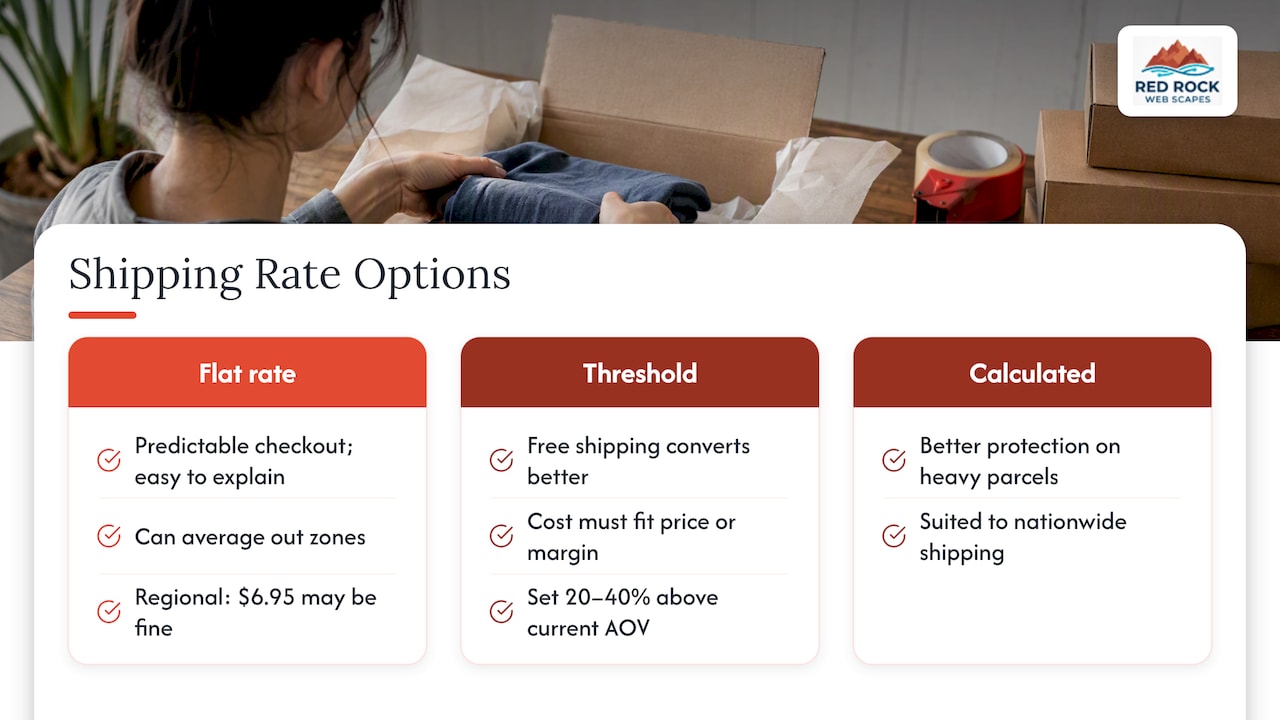
A flat rate also lets you quietly average out zones. If most customers are regional, a $6.95 charge may be fine. If you ship nationwide with heavy items, calculated rates protect you better.
Step 3: Pick carriers and use small-business rate programs
The biggest avoidable mistake is paying retail rates at the counter. USPS notes that shipping online through Click-N-Ship gets you lower Commercial Rates on many services. Its own example: Priority Mail Express commercial pricing starts at $31.51 against $37.05 at the Post Office.
Your main options as a small U.S. seller:
- USPS Ground Advantage. USPS describes it as delivering in 2 to 5 days, with tracking and insurance included. It is a natural default for light parcels.
- USPS Connect eCommerce. A route for merchants to access USPS commercial pricing and services without enterprise volume.
- UPS Small Business Rates. UPS says these simplified rates are built for small shippers, with fewer surcharges than standard rates. Heavier or bulkier parcels often compare well here, so quote both.
- Regional carriers. In some metro areas a regional carrier beats the nationals on price and speed for local zones. Get a quote before assuming.
Rates and surcharges change, and USPS has adjusted commercial pricing several times in recent years, so check the current rate card before you finalize a threshold. Do not sign a long contract on assumption: quote three real parcels (light, average, heavy) across near and far zones, on two carriers, and compare totals including surcharges.
Reduce cost without hurting the experience
- Right-size packaging. Oversized boxes raise dimensional weight charges and waste filler. Order two or three standard box sizes that fit 90% of orders.
- Print labels online. It is cheaper than the counter and creates tracking automatically.
- Use real weights. Calculated rates are only as good as the product weights and dimensions in your catalog. Wrong data creates either lost margin or inflated checkout prices.
- Keep insurance proportionate. USPS lists insurance up to $100 per package with Ground Advantage. For higher-value items, price extra coverage into the product.
Step 4: Set delivery promises you can keep
Show shoppers two dates: when it ships and when it arrives. Build your promise from your handling time plus the carrier’s slower range, not the faster one. If you pack within one business day and Ground Advantage takes 2 to 5 days, say “arrives in 3 to 6 business days” and be pleasantly early rather than quietly late.
Three habits that earn trust:
- Cutoff times. “Order by 2 p.m. Pacific to ship today” is specific and believable.
- Holiday notices. Post last-order dates early, and update them honestly.
- Proactive delay messages. The McKinsey research notes that roughly half of consumers track their orders, and shops that tell customers about delays before they notice earn more trust and fewer where-is-my-order emails.
If you offer expedited options, label them clearly and price them near cost. Few buyers choose them, but their presence answers the “what if I need it sooner” objection.
Step 5: Write a shipping and returns policy shoppers actually read
Your policy page is a sales page. It should be short, scannable and linked from the product page, cart and footer. Include:
- Where you ship, and what you do not (for example, P.O. boxes, international, or specific states for restricted goods).
- Handling time and delivery windows by method.
- Costs, including your free-shipping threshold, stated in dollars.
- Tracking: when the customer receives the number and where to find it.
- Lost, damaged or wrong items: who to contact, what proof you need and what you do (reship or refund).
- Returns: window, condition, who pays for the label and how refunds are issued.
Returns are a strategic choice
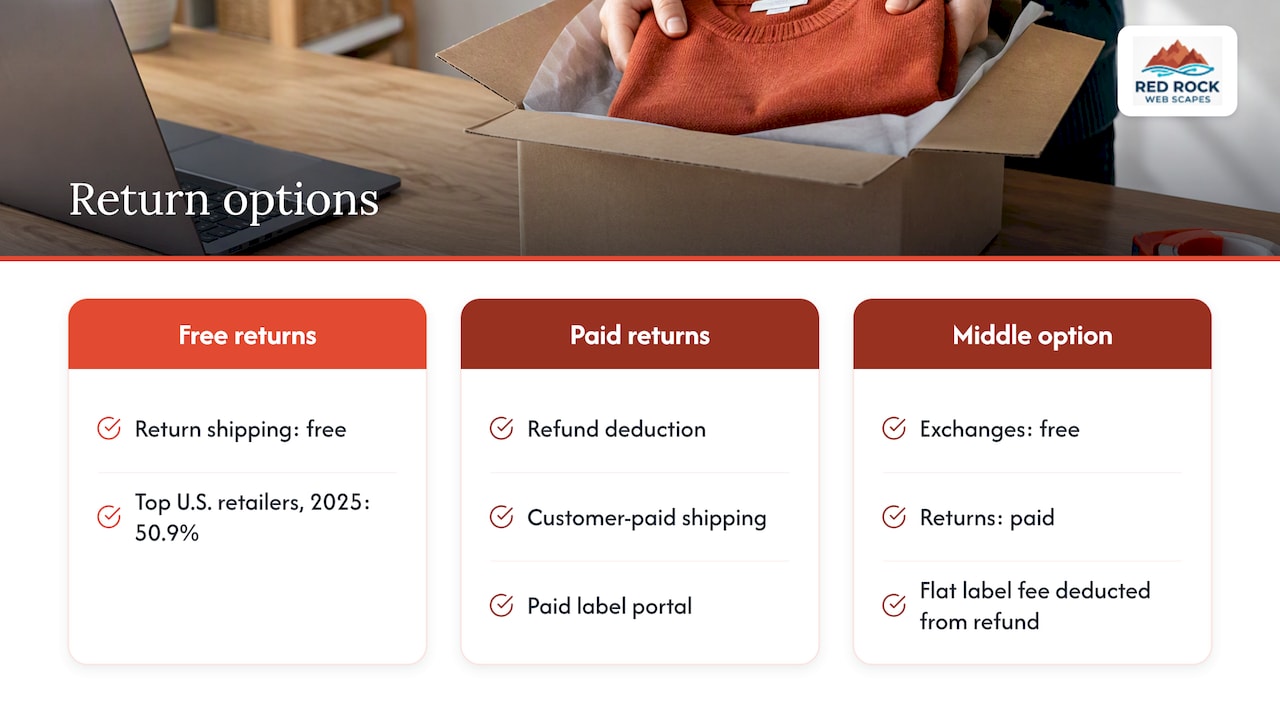
Free returns are not universal. The McKinsey analysis reports that only 50.9% of top U.S. retailers offered free returns in 2025. The rest charge through refund deductions, customer-paid shipping or paid label portals. As a small store you can choose either, but be explicit. Many small sellers use a middle option: free exchanges, paid returns, with a flat label fee deducted from the refund.
If you issue return labels, learn the carrier’s rules. USPS Return Services offers tools to make returns easier, and USPS lists a $0.25 noncompliance fee per label when the Intelligent Mail package barcode and matrix barcode do not match. Small costs like this add up when you scale.
Write the policy in plain English, not copied legalese, and have a lawyer review it if you sell regulated or high-value goods. If you offer a satisfaction guarantee, say exactly what it covers.
Step 6: Set it up in your store
The strategy only works when the checkout reflects it. On most platforms the workflow is the same:
- Create shipping zones. Start with the contiguous U.S., then add Alaska, Hawaii, territories and international separately, since they cost more.
- Add rates per zone. Shopify’s help center shows how to set flat, price-based and weight-based rates, including an example of free shipping above an order value. Other platforms offer equivalent settings.
- Enter accurate weights and dimensions for every product and variant.
- Connect labels and tracking. Pick a label tool or carrier integration that pushes tracking numbers into the order and the customer’s email automatically.
- Show the promise at product and cart level. A free-shipping progress bar in the cart (“You’re $14 away from free shipping”) works well when the threshold is real.
- Test with real addresses. Place test orders to a Nevada address, a California one, Hawaii and a rural ZIP. Check that the totals match your spreadsheet.
- Review monthly. Compare shipping revenue collected against postage paid, then adjust the rates or threshold.
Automation matters more than most founders expect. Shipping APIs and integrations that print labels and push tracking back into your store are not just for enterprises, and building them in at launch is far easier than retrofitting them after manual order emails pile up.
Our perspective
We build online stores for small businesses, and the same pattern repeats: owners treat shipping as something to sort out after the design is done. By then the checkout layout, product data and policy pages are already set, and changing them costs time and money.
Our advice is to decide the shipping model during planning. Know your average order value, your parcel sizes and the threshold you want before a single page is designed, because those facts decide where the cart message goes, how product data is structured and which integrations the store needs. Pair that with the basics we cover in our guide to raising a small store’s conversion rate: clear checkout, fast pages and visible trust signals. Clear shipping terms sit at the center of all three.
The other thing we tell clients: start simple. One flat rate, one free-over threshold and one reliable carrier is a perfectly good launch strategy. Collect a month of real orders, then refine. You can also see how this fits into the rest of your launch in our ecommerce launch checklist.
— George
Getting the store built to match
If you are planning a new store, shipping rules, product data and checkout design are easier to get right when they are built together. Our ecommerce web design for Las Vegas businesses covers Brick & Mortar builds from 2,500 USD, E-Tail from 3,500 USD and Dropshipping from 4,000 USD, all one-off. Our Website Launchpad program offers a lower-upfront route: an e-commerce store build setup fee of 150 USD one-off, with Commerce Care at 199 USD per month for ongoing support. If you are still working out budgets, our small business website cost guide lays out the options.
FAQ
Is free shipping or flat rate better for a small store?
Neither wins everywhere. Free shipping converts well but only if your margin or prices absorb the cost. Flat rate is more predictable. Many small stores do best with a flat rate under a threshold and free shipping above it, which also lifts average order value. Start from your own cost spreadsheet, then test.
Do I need a long contract to get decent carrier rates?
No. USPS offers Connect eCommerce for merchants, and UPS offers Small Business Rates built for smaller shippers. Compare quotes on your actual parcels before committing to anything.
What should a shipping policy for an online store include?
Cover where you ship, handling time, delivery windows, costs and your free-shipping threshold, tracking, what happens with lost or damaged orders, and your returns terms including who pays for return labels. Keep it short and link it from product pages, the cart and the footer.
Should I offer free returns?
It depends on your margins and return rate. According to McKinsey, only about half of top U.S. retailers offer free returns, so paid returns are normal if clearly stated. Free exchanges with paid returns are a common compromise.
When should I set up shipping in a new store?
During planning, before design is finished. Shipping rules affect product data, cart messaging, integrations and policy pages, and they are cheaper to build in than to add later.
Sources
- McKinsey: What do US consumers want from e-commerce deliveries?
- DHL E-Commerce Trends Report 2025
- USPS Business Shipping
- USPS Connect eCommerce for Merchants
- USPS Ground Advantage for Business
- USPS Return Services
- UPS Small Business Rates
- Shopify Help Center: Setting up shipping zones and rates