Gorgias is the better fit for most small and mid-sized online stores, especially on Shopify: it is built only for e-commerce, goes live fast, and charges by ticket volume with unlimited agents. Zendesk is the better fit when you have a larger team, several channels or brands, or support needs beyond retail. The deciding number is simple: how many tickets you handle per agent each month. Below, you get current US prices, the math on where the two cross over, and a short way to choose.
Key Takeaways
- Pricing models differ. Gorgias bills by monthly ticket volume with unlimited users, while Zendesk bills per agent seat.
- Few agents, many tickets: Zendesk can be cheaper. Many agents, moderate tickets: Gorgias usually wins. One published example puts the crossover near five agents at 2,000 tickets a month.
- Gorgias is narrower and faster to set up. Zendesk is more configurable and takes longer.
- AI is billed differently too. Gorgias charges per automated resolution, so price your AI volume before you commit.
- Fix what causes tickets first. A clear store, checkout and shipping page lowers volume on either tool.
Table of Contents
- What Gorgias and Zendesk are built for
- Gorgias vs Zendesk at a glance
- Pricing: ticket math versus seat math
- AI: resolve-and-sell versus resolve-at-scale
- Features, usability and Shopify depth
- Trade-offs to plan for
- Which one should you pick?
- Cut tickets before you buy software
- Perspective: build the store so support has less to do
- Launching a store that needs less support
- FAQ
- Sources
What Gorgias and Zendesk are built for
Gorgias describes itself as an e-commerce conversational-AI customer-experience platform. It combines a helpdesk, an AI Agent, chat, FAQ and omnichannel support with a Shopify integration, and it frames support as a revenue channel as well as a cost.
Zendesk positions itself as an AI-first customer-service platform. It covers email, messaging, live chat, phone, social channels and help centers, with ticketing, a knowledge base, workflow automation and analytics.
The practical split: Gorgias is designed specifically for e-commerce, while Zendesk is a general-purpose omnichannel platform suited to many industries and complex organizations. If every ticket you get is “where is my order” or “I need a refund,” you are the shopper Gorgias was made for. If your inbox also carries B2B accounts, IT requests or phone queues, Zendesk’s breadth starts to matter.
Gorgias vs Zendesk at a glance
| Gorgias | Zendesk | |
|---|---|---|
| Built for | E-commerce brands, mainly Shopify | Any industry, including large operations |
| Pricing basis | Tickets per month, unlimited agents | Per agent per month |
| Entry price | $10/month (Starter) | $19 per agent/month, billed yearly (Support Team) |
| AI billing | Per automated resolution | Included in Suite tiers, with add-on usage options |
| Setup | Typically within a week | Longer, more configuration |
| Custom reporting | Limited in-app, export data | Pre-built and custom reports |
| Best for | Small to mid-sized online stores | Larger teams, multi-channel or multi-brand support |
Pricing: ticket math versus seat math
This is where most buyers decide, and it is where most comparisons get muddy. Here are the published US list prices.
Gorgias plans
According to the Gorgias pricing page:
| Plan | Monthly price | Included tickets |
|---|---|---|
| Starter | $10 (billed monthly) | 50 tickets, plus 30 automated AI interactions |
| Basic | $50 billed annually, $60 monthly | 300 tickets |
| Pro | $300 billed annually, $360 monthly | 2,000 tickets |
| Advanced | $750 billed annually, $900 monthly | 5,000 tickets |
| Enterprise | Custom | Custom |
Overage runs $0.40 per ticket on Starter and Basic and $0.36 per ticket on Pro and Advanced. Agents are unlimited, so hiring a seasonal helper does not change your bill. A ticket spike does.
Zendesk plans
Per the Zendesk pricing page, all prices are per agent per month when paid yearly:
- Support Team, $19: email ticketing, routing, prebuilt analytics dashboards, pre-written responses, customer context, automations and triggers.
- Suite Team, $55: adds AI Agents, an AI knowledge base, AI Action Builder, omnichannel routing, messaging and live chat, and telephony.
- Suite Professional, $115: adds Admin Copilot, App Builder, writing tools, quick reports, skills-based routing and an IVR phone tree.
- Suite Enterprise + Copilot: contact sales.
Notice what the cheap tier leaves out. Support Team is email-style ticketing. Live chat and the AI agent features sit in Suite Team and above, so a store that wants chat plus AI should compare against $55, not $19.
Where the two cross over
Same ticket volume, opposite winners depending on headcount. Tidio’s October 2026 comparison gives these examples:
| Scenario | Gorgias | Zendesk |
|---|---|---|
| 2 agents, 300 tickets/month | $50 (Basic) | $38 (Support Team) or $110 (Suite Team) |
| 10 agents, 2,000 tickets/month | $300 (Pro) | $190 (Support Team) or $550 (Suite Team) |
| 5 agents, 2,000 tickets/month | $300 (Pro) | $275 (Suite Team), roughly the crossover |
Richpanel’s July 2026 analysis adds a rule of thumb. At annual prices, Gorgias Pro and Advanced work out to about $0.15 per included ticket, and the estimated crossover against Zendesk is about 125 tickets per agent per month for Support Team, 370 for Suite Team and 770 for Suite Professional. Its volume example shows the swing: 4,000 tickets a month with 10 agents favors Gorgias Advanced at about $747 over Zendesk Suite Professional at $1,150, while the same volume with 4 agents favors Zendesk at $460.
Translate that to your store:
- Count tickets last month, including chat and social if you plan to route them.
- Divide by the number of people answering.
- If each person handles more than a few hundred tickets, Zendesk’s seat price gets expensive and Gorgias tends to win. If each person handles very few, seat pricing is the cheaper path.
These are base prices before AI and add-ons, so treat them as a floor. Both vendors change plans often, so confirm on their pages before you buy.
AI: resolve-and-sell versus resolve-at-scale
Both platforms now lead with AI agents, and the billing is the difference you will feel.
Gorgias prices its AI Agent per resolved interaction: roughly $0.90 per automated resolution on most plans, with monthly interaction allotments that vary by plan (as of May 2026). The same page lists tone-of-voice customization, image understanding and automatic handover to a human when confidence is low.
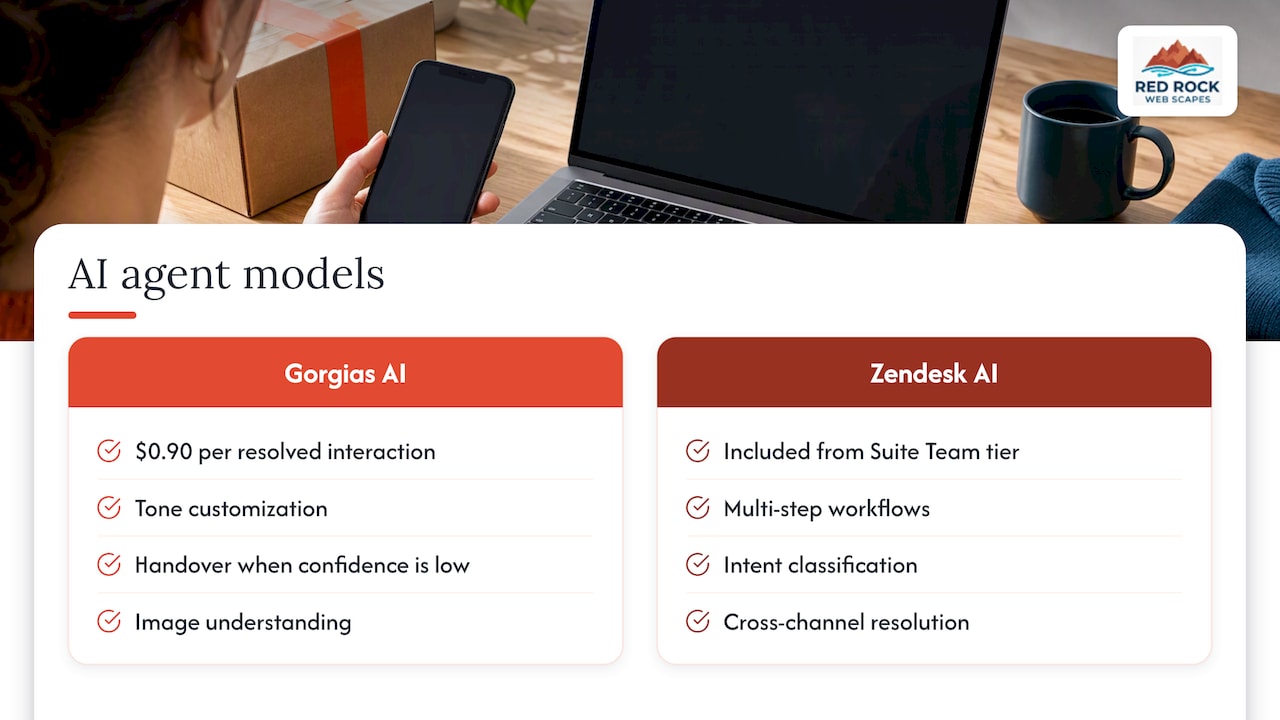
Zendesk’s AI agents handle multi-step workflows, intent classification and autonomous resolution across messaging, email and voice. On the seat plans, AI Agents begin at the Suite Team tier.
On third-party reviews, G2 gives Gorgias 9.7 for AI text generation and summarization, against 7.2 and 7.7 for Zendesk. Treat review scores as a signal of user satisfaction, not a benchmark of answer quality.
Before you switch AI on, estimate how many of your tickets are repetitive (order status, returns policy, sizing). Multiply by the per-resolution fee and compare that with the labor you would save. That figure, not the headline plan price, is your real monthly cost.
Features, usability and Shopify depth
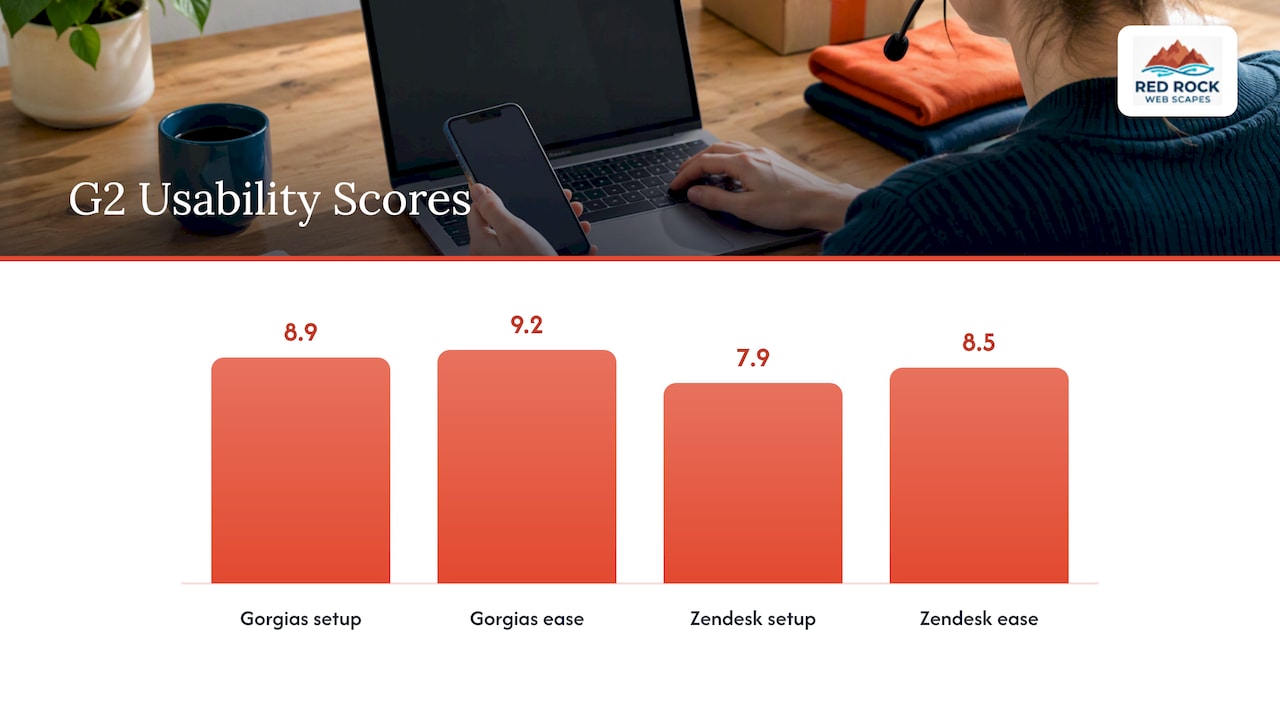
Ease of use. On G2, Gorgias scores 8.9 for ease of setup and 9.2 for ease of use, versus 7.9 and 8.5 for Zendesk. That matches the broader pattern: Gorgias has a smaller admin surface and most reviewers report going live within a week, while Zendesk is more configurable and typically takes longer.
Order actions inside the ticket. Gorgias lets agents edit orders, cancel orders and process refunds directly in the ticket. One comparison says Zendesk’s Shopify integration is read-only for those actions and may need third-party apps, so test this in a trial against your own order flow.
Reporting and community. Zendesk offers real-time and historical data with pre-built and custom reports, plus community forums. Gorgias users export data for custom reporting and do not get forums. Zendesk’s own page is the source here, so weigh it as the competitor’s view and check the Gorgias reporting screens in a demo.
Ecosystem. Zendesk lists 1,500+ integrations and broad channel coverage for large support organizations. That is a real advantage if you need skills-based routing, SLAs, a sandbox or voice, which Tidio also flags as Zendesk strengths.
Trade-offs to plan for
Neither tool is a bad choice. Each has a cost you should plan for:
- Gorgias fits best on Shopify. It is a weaker fit for non-Shopify platforms, enterprise compliance, IT service management and advanced custom reporting.
- Gorgias cost behavior: Contra Collective notes the bill can climb when operational problems drive up ticket volume. Late shipments and confusing policies become a line item.
- Zendesk needs more setup and upkeep, and per-seat pricing plus add-ons can raise costs as you grow. The same source says its e-commerce data layer may need configuration work.
The ticket-volume point is the one most store owners miss. On Gorgias, every avoidable question costs money. On Zendesk, every extra person costs money. Either way, fewer tickets is the cheapest lever.
Which one should you pick?
Choose Gorgias if:
- You run a Shopify store and most tickets are order-related.
- You have a small team, or a team that changes size with the seasons.
- You want to be live in days, not weeks.
- You want support to double as a sales channel.
Choose Zendesk if:
- You have a larger team handling few tickets each, or complex routing needs.
- You support multiple brands or channels, including phone.
- You need enterprise governance, a sandbox or a wide app marketplace.
- Your business is not only retail, or not on Shopify.
If you are below about 50 tickets a month, you may not need either at full price. Gorgias Starter is $10 a month, and a shared inbox may do until volume grows.
Cut tickets before you buy software
A helpdesk manages questions. A good website prevents them. The most common avoidable tickets come from unclear shipping times, hidden return policies, product pages that skip sizing or compatibility, and checkout friction. Accessibility problems count too: shoppers who cannot complete checkout end up writing to support, and finding and fixing checkout traps removes tickets and lost sales at once.
A practical routine: tag your first 100 tickets by cause, then fix the top three on the site. Do this before you size a plan. You may land one tier lower on Gorgias or need fewer Zendesk seats.
Perspective: build the store so support has less to do
We build small-business and e-commerce sites, and we see the same pattern after launch. Owners buy a helpdesk because tickets are piling up, then discover that most of those tickets trace back to the website: a return policy buried in the footer, shipping times that do not match the checkout, a product page that leaves out the one detail people ask about.
That is why we treat support as part of the build, not an afterthought. Our work on e-commerce sites pairs custom design with advanced SEO and responsive layouts, and we use AI-assisted development to move faster without cutting the planning step where these questions get answered. Our AI consulting is aimed at exactly the workflow questions in this article: what to automate, what to leave to a person, and how to keep the process simple for a small team.
Our advice is to pick the helpdesk that matches your ticket math, then make the site answer the repeat questions before they arrive. Small teams win by being clear, not by adding tools.
George
Launching a store that needs less support
If you are planning a new store, we can build it with these questions already answered. Our Commerce package starts at $2,000 one-off, and our e-commerce builds start at $2,500 for Brick & Mortar, $3,500 for E-Tail and $4,000 for Dropshipping.
Through the Website Launchpad program, you launch with a low upfront cost: an e-commerce store build setup fee of $150 one-off, then a managed care plan. Commerce Care is $199 per month, Growth Care is $149 per month and Managed Core is $79 per month. Business email is $29 per month. Choose your helpdesk after launch, once real tickets show you which plan size makes sense. Talk to us about your store.
FAQ
Is Gorgias cheaper than Zendesk?
It depends on your agents-to-tickets ratio. Gorgias starts at $10 a month and charges by ticket volume with unlimited agents, while Zendesk starts at $19 per agent per month billed yearly. Teams with many agents and moderate volume usually pay less on Gorgias. Teams with few agents and high volume often pay less on Zendesk.
Does Gorgias work without Shopify?
Gorgias is built mainly for e-commerce brands and is strongest on Shopify. Its official site centers on its Shopify integration. If your store runs on another platform, or you support non-retail customers, confirm integration support in a trial before paying, or look at Zendesk’s broader marketplace.
How much does AI support cost on each platform?
Gorgias charges roughly $0.90 per automated resolution on most plans, with monthly allotments that vary by plan, according to its AI Agent pricing article. On Zendesk, AI Agents start at the Suite Team tier, $55 per agent per month billed yearly. Estimate how many repetitive tickets you get before choosing.
Can I switch later if I choose wrong?
Yes, but plan for effort. You will need to move macros, automations and integrations, and retrain staff. Start with the plan that fits your current ticket volume and headcount, and review it each quarter. A seasonal spike on Gorgias or a hiring jump on Zendesk is your signal to recheck the math.
Sources
- Gorgias pricing
- Gorgias homepage
- Gorgias AI Agent pricing explained
- Zendesk pricing
- Zendesk homepage
- Zendesk vs. Gorgias
- Zendesk AI agents for customer service
- Tidio: Gorgias vs Zendesk pricing and features
- Richpanel: Gorgias vs Zendesk head-to-head
- G2: Gorgias and Zendesk Support Suite comparison
- eesel AI: Gorgias vs Zendesk for e-commerce support
- Listicler: Gorgias vs Zendesk for e-commerce support
- Zipchat: Gorgias vs Zendesk for Shopify
- Contra Collective: Gorgias vs Zendesk for Shopify
- AccessWiser: ecommerce accessibility and checkout traps