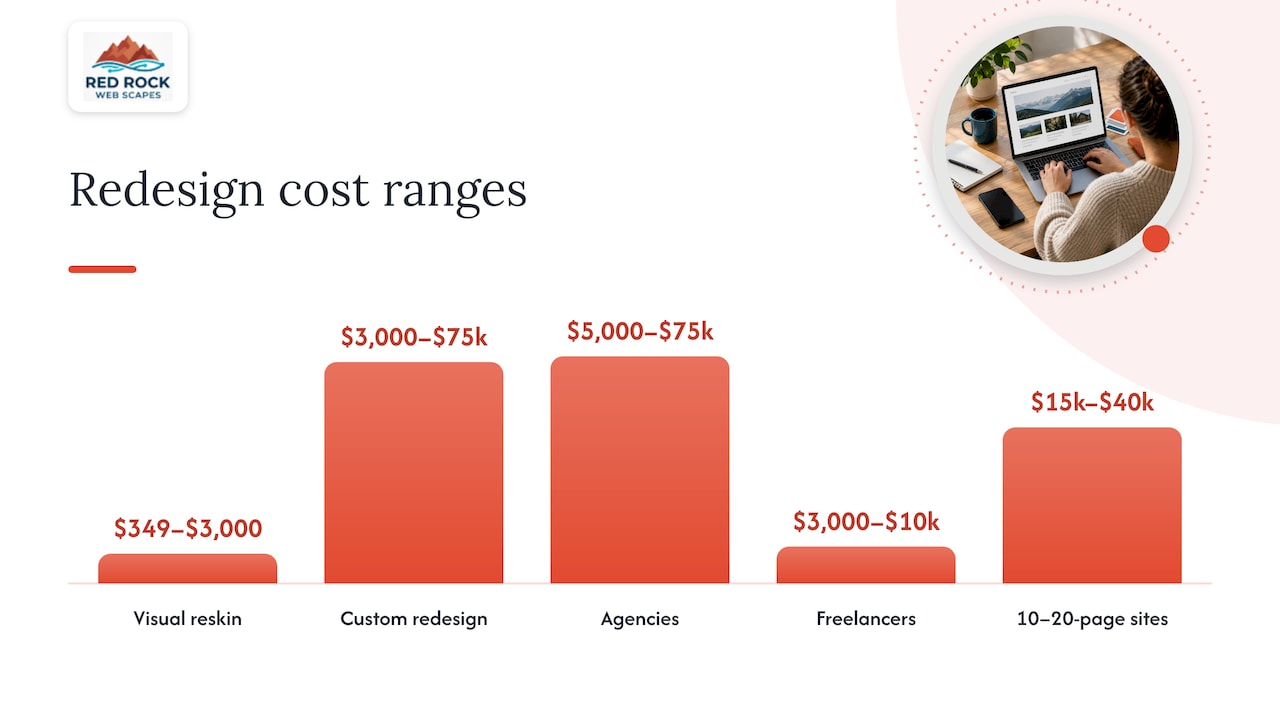
A website redesign costs anywhere from a few hundred dollars for a visual reskin to well over $75,000 for a complex rebuild. Most small businesses land in the low-to-mid four figures if they work with a small studio or freelancer, and in the tens of thousands if they hire a mid-size agency. The gap is huge because the published numbers are measuring different things: pages, features, content, migration work and who does the job.
This guide breaks the cost into parts you can budget line by line, shows what the published ranges really mean, and flags the expenses that catch owners off guard.
Key takeaways
- Scope sets the price more than anything else. A reskin that keeps your structure is the cheapest route, and a new strategy, layout and CMS is the most expensive.
- Published agency ranges vary wildly. Some guides put a small business redesign at $15,000 to $40,000, while the median US agency price for a five-page site is far lower.
- Budget beyond the build: hosting, maintenance, SEO protection during migration, content and accessibility work all sit outside the design quote.
- A redesign is not always the answer. If your problem is mobile usability or speed, a targeted fix can cost a fraction of a rebuild.
- Ask for fixed scope, milestone payments and a written performance target before you sign anything.
Table of Contents
- What a website redesign costs in 2026
- A website budget breakdown, line by line
- What drives the price up
- Costs people forget
- Do you need a full redesign?
- How to spend less without cutting corners
- Our perspective
- What a redesign with us looks like
- Frequently asked questions
- Sources
What a website redesign costs in 2026
The honest answer is a spread, and it helps to read it in three tiers.
| Tier | What it means | Typical range |
|---|---|---|
| Visual reskin | New look, same structure and content | $349 to $3,000 |
| Full custom redesign | New strategy, layout and page flow | $3,000 to $75,000 |
| Complex rebuild | New CMS, integrations, headless architecture | $75,000 and up, often above $150,000 |
Who you hire moves the number too. One agency pricing guide says agencies charge $5,000 to $75,000, freelancers $3,000 to $10,000 for a redesign. Another agency says small business sites of 10 to 20 pages typically cost $15,000 to $40,000. Those figures come from agencies selling at the higher end of the market, so treat them as a ceiling for a typical small business, not a floor.
The most useful single data point for a small business may be the US agency report from Lindo.ai: a median project size of $3,850 for a five-page site, a median hourly rate of $125, and prices up 12% year over year. If you are a local shop, a service company or a startup with a small catalog, that is a more realistic anchor than a five-figure enterprise quote.
A website budget breakdown, line by line
A quote for “the redesign” usually hides several separate jobs. Splitting them out makes quotes comparable and shows you where you can save.
Strategy and planning
This covers a content audit, a sitemap, and a decision about what to keep, merge or delete. On a small site it may be a few hours. On a larger one it is a paid discovery phase. Skipping it is the most common reason redesigns run over budget, because scope gets decided halfway through the build.
Design
Design is the visible part: layout, typography, mobile views, imagery. A template-based design costs the least. A fully custom design costs the most, because every page type is drawn from scratch. For most small businesses, a custom homepage with a handful of well-built templates for the inner pages is the sweet spot.
Development and platform
This is the build in WordPress, Shopify, Webflow or custom code. Add e-commerce, booking, member areas or custom calculators and the price climbs, since each is its own mini project. If you sell online, plan for the store setup, payment gateway, shipping and tax settings as separate line items.
Content and photography
New copy, product descriptions and photos are often excluded from the design quote. If you will not write them yourself, price them separately. Good photography of your actual work, team or products usually beats stock imagery for trust.
SEO protection during migration
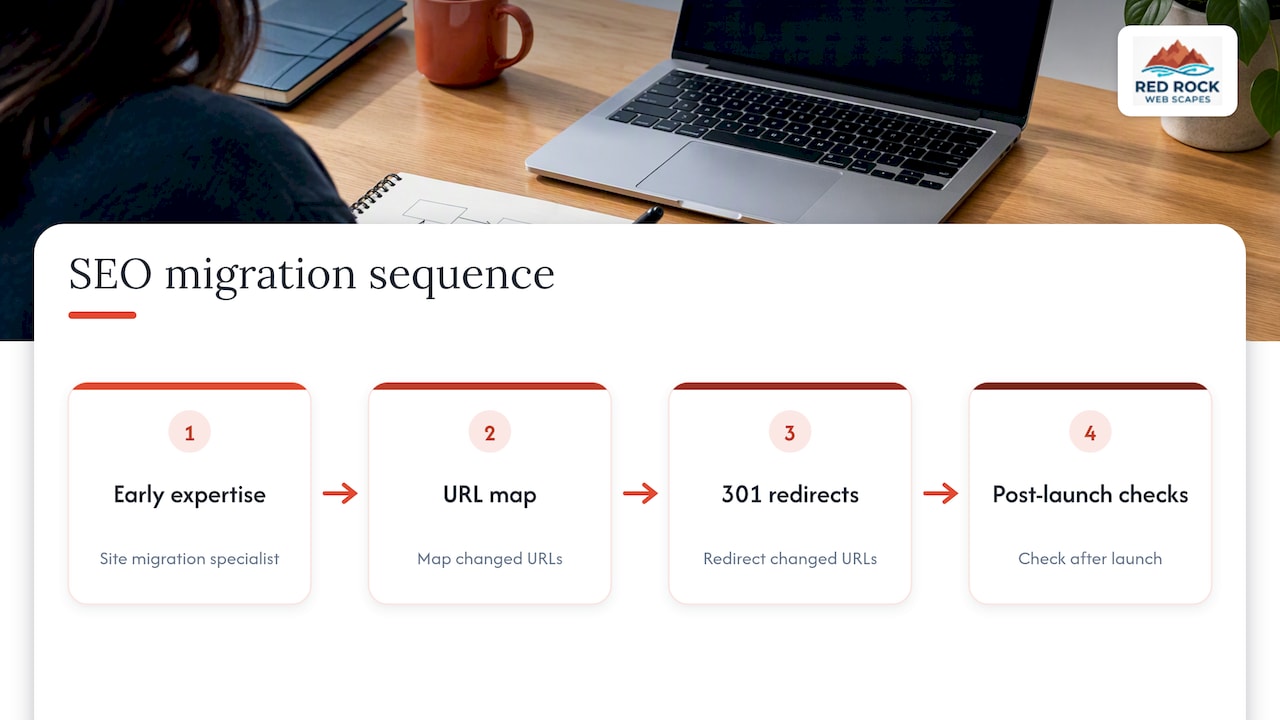
This is the line owners forget. A redesign that changes URLs without redirects can wipe out rankings you spent years earning. Search Engine Land advises that if you have invested in SEO, you should bring in someone familiar with site migrations early in the project. Budget for a URL map, 301 redirects and post-launch checks. We cover the mechanics in our SEO migration checklist.
Hosting, email and maintenance
The site does not stop costing money at launch. One consumer guide pegs hosting and apps at $15 to $150 a month for a typical small business site, with maintenance on top. Ongoing care is where many sites quietly decay, so decide up front who updates plugins, runs backups and fixes what breaks. Our website maintenance plan guide walks through a 30-minute audit you can run yourself.
What drives the price up
Five things move a quote more than the rest:
- Page count. Every unique page type needs design and testing, not just copy.
- Custom functionality. Quote calculators, booking engines, portals and integrations with your CRM or inventory system.
- E-commerce. Product catalogs, variants, checkout, subscriptions and shipping rules.
- Content volume. Rewriting 40 service pages costs far more than refreshing five.
- Migration complexity. Moving platforms, merging domains or changing URL structure adds technical work.
If you want a quick sense of how this plays out at a small scale, our post on small business website cost across three budgets lays out what each budget level buys and includes a vendor checklist.
Costs people forget
Accessibility
The Department of Justice says that websites must be accessible to people with disabilities, and its rule for state and local governments sets WCAG 2.1 Level AA as the technical standard. That rule applies to public entities, not private businesses. Still, WCAG 2.1 AA is the benchmark most owners and lawyers point to, so ask any designer you hire how they test for it. If your business has had an accessibility complaint, talk to an attorney who handles ADA matters before you finalize the scope.
Performance targets
Google’s page experience signals include Core Web Vitals: Largest Contentful Paint, Interaction to Next Paint and Cumulative Layout Shift. You can see them per URL in Google Search Console. Search Engine Land’s advice is not to accept a designer’s promise that performance “will be fine”, and instead to write Core Web Vitals into the project requirements as a success metric. It costs nothing to add and saves a lot of rework.
Training and handoff
If nobody on your team can edit the new site, every small change becomes a paid request. Ask whether training, documentation or a support allowance is included.
Your own time
Reviewing drafts, supplying content and approving pages takes real hours. Slow feedback stretches timelines, and on hourly work it raises the bill.
Do you need a full redesign?
Sometimes a rebuild is the wrong spend. The US Department of Labor’s guidance on mobile usability notes that you can improve a site by adding a presentation layer with CSS or JavaScript instead of rewriting everything, which can take days or months rather than the four-plus months of a full redesign.
A full redesign makes sense when:
- Your platform is outdated, insecure or too slow to fix.
- Your site structure no longer matches how you sell or what you offer.
- You are adding e-commerce or a major feature.
- Visitors reach the site but do not call, book or buy, and the cause is the layout itself.
A lighter refresh makes sense when the structure works and the problem is looks, speed or mobile layout. The SBA treats a website as an ongoing business tool rather than a one-time project, so a series of smaller, planned updates is often cheaper than a big rebuild every five years. If you are moving off a site builder, see our guide to moving Wix to WordPress without losing SEO for sites under 15 pages.
How to spend less without cutting corners
- Cut pages, not quality. Merge thin pages and delete ones nobody visits before you design anything.
- Write your own first drafts. An editor is cheaper than a writer starting from scratch.
- Choose a platform you can maintain. A site only a developer can edit costs more over three years.
- Pay in milestones. Tie payments to delivered work, such as approved design, working build and launch.
- Get fixed-scope quotes. Hourly estimates without a cap are the usual source of surprise invoices.
- Phase the extras. Launch the core site first and add a blog, store or portal later.
When you compare quotes, ask each vendor the same five questions: What is included? What is not? Who owns the files and the domain? What happens to my URLs? What does month 13 cost?
Our perspective
We build small business sites in Las Vegas and work with e-commerce founders across Nevada and California. The pattern we see most is not owners overpaying for design. It is owners underbudgeting for everything around it: the migration, the content, the hosting and the care after launch. A beautiful site that loses its search rankings or slows to a crawl does not earn its keep.
So we price in pieces. Our Website Launchpad program keeps the upfront cost low and moves the ongoing care into a monthly plan, so a young business is not asked to fund everything on day one. We use AI-assisted development to shorten build cycles, but the decisions about structure, speed and SEO stay with people who have done it before.
Our advice: decide what the site must do in the next 12 months, build exactly that, and keep a small monthly budget for improvements. That beats a large one-time spend and a site nobody touches for four years.
— George
What a redesign with us looks like
Our pricing is published where we can state it. Packages are on our packages page: Commerce starts at $2,000 one-off and Signature at $2,500 one-off, while Launch, Essential and Growth are quoted to the project. For online stores, our e-commerce builds start at $2,500 for Brick & Mortar, $3,500 for E-Tail and $4,000 for Dropshipping, all one-off.
Through the Website Launchpad, a standard business build carries a $99 one-off setup fee and an e-commerce store build a $150 one-off setup fee. Ongoing care is Managed Core at $79 per month, Growth Care at $149 per month and Commerce Care at $199 per month. Business email is $29 per month.
If you are in the Las Vegas area, see our web design page or get in touch through the main site with your current URL, and we will tell you whether you need a rebuild or a lighter refresh.
Frequently asked questions
How much does it cost to update an existing website?
It depends on how deep the update goes. A visual refresh that keeps your structure can run from about $349 to $3,000, while new layouts and strategy start around $3,000. Small edits such as text, images and plugin updates are usually cheaper on a support plan than as one-off projects.
How often should you redesign a website?
There is no fixed schedule. Many owners revisit the full design every few years, but the SBA’s view is that a site is an ongoing tool, so smaller improvements in between keep each big overhaul smaller. Redesign sooner if your platform is outdated, your mobile experience is poor, or your site no longer reflects what you sell.
Will a redesign hurt my Google rankings?
It can if URLs change without redirects or if the new site is slower. Plan a URL map, set up 301 redirects and track Core Web Vitals before and after launch in Search Console. Handled properly, a redesign should hold your rankings and often improve them.
Is it cheaper to use a freelancer or an agency?
Usually, yes: one agency guide lists freelancers at $3,000 to $10,000 and agencies at $5,000 to $75,000. The trade-off is capacity and breadth. A small studio can sit between the two, with a team for design, development and SEO but without enterprise overhead.
What should a small business budget for a website each year?
Plan for the build, then for running costs. A typical consumer guide estimates $15 to $150 a month for hosting and apps, plus maintenance, and you should add a small allowance for content and SEO. Your own total depends on whether you sell online and how much you update.
Sources
- State of Web Design Agencies in the US, 2026 (Lindo.ai)
- Website redesign cost and pricing (Clique Studios)
- Website Redesign Pricing (WebFX)
- How Much Does A Website Cost? (Forbes Advisor)
- How to avoid an SEO disaster during a website redesign (Search Engine Land)
- Ways to approach mobile usability (U.S. Department of Labor)
- Guidance on Web Accessibility and the ADA (ADA.gov)
- Accessibility of Web Information and Services of State and Local Government Entities (ADA.gov)
- Core Web Vitals report (Google Search Console Help)
- U.S. Small Business Administration