A good return policy for an online store does four things. It states how long customers have to return an item, what condition the item must be in, who pays for shipping, and how the refund arrives. It sits where shoppers can find it before they pay. Everything else is detail, and the detail is where small stores either earn trust or invite disputes.
This guide walks through each decision, the U.S. rules that apply, and a template you can adapt. It is written for owners of small stores who need a policy that protects margin without scaring buyers off.
Key takeaways
- Decide five things in writing: return window, item condition, fees, refund method and exchanges. Then put the policy in the footer, on product pages and at checkout.
- No federal law forces a store to accept returns for a change of mind, but states such as California require clear disclosure of your terms, and the FTC sets firm rules on shipping delays and refunds.
- A window of 30 days is the common starting point. A clear, fair policy tends to reduce buyer anxiety rather than increase returns.
- Treat returns as a process, not a page: issue return authorization numbers, inspect and sort returns consistently, and track reasons.
- Digital goods, final-sale items and low-value products each need their own wording.
Table of Contents
- What the law does and does not require
- The five decisions every policy needs
- Where the sections can differ by product type
- Run returns as a process, not just a page
- Where to show the policy
- A return policy template you can adapt
- Our perspective: policy is a design problem
- Build the policy into your store
- FAQ
- Sources
What the law does and does not require
Start with the legal floor, because it shapes what you can promise.
There is no general federal right to return a purchase just because the shopper changed their mind. What exists instead is a patchwork: shipping and refund rules from the FTC, state disclosure laws, and card network and lender rules that govern disputes.
The FTC rule on shipping delays
The FTC’s Mail, Internet, or Telephone Order Merchandise Rule requires you to ship within the time you promise, or within 30 days if you gave no time. If you cannot, you must tell the customer promptly and offer a choice: accept the delay or cancel for a full, prompt refund. The same page sets refund timing: for payments by cash, check or third-party credit, refunds are due within seven working days of cancellation, and for credit where the merchant is the creditor, the account must be credited within one billing cycle.
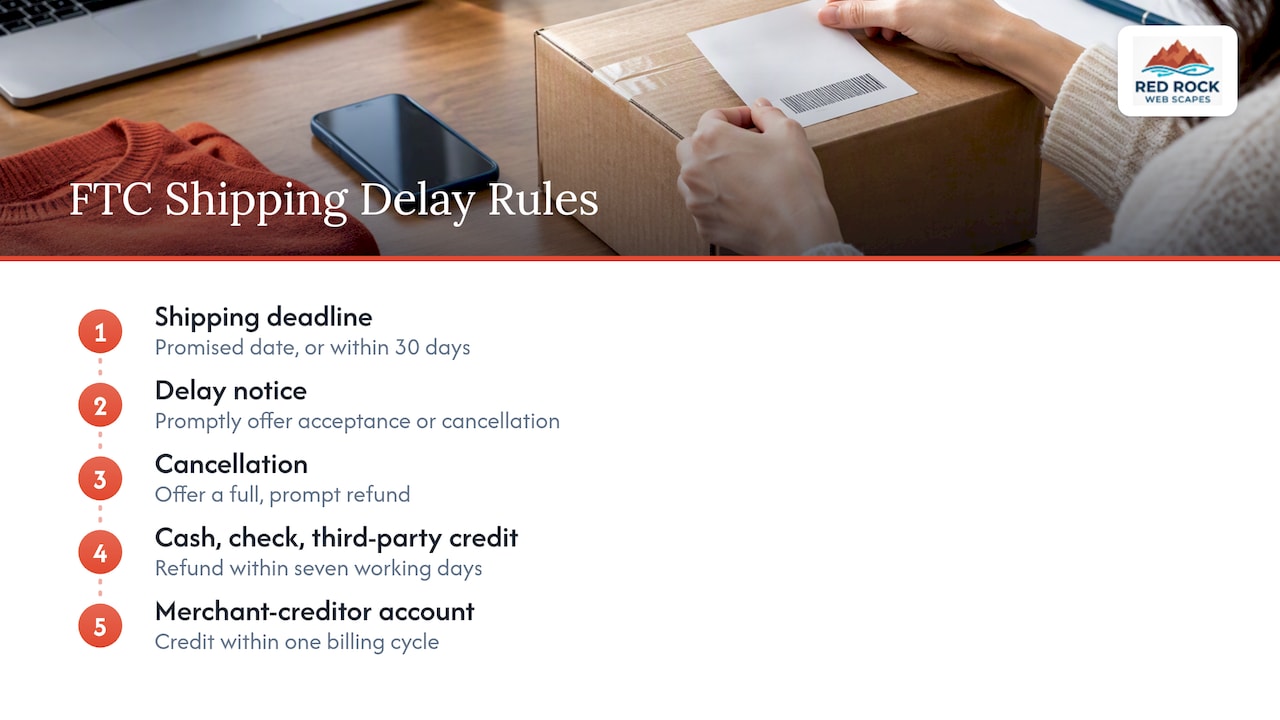
The FTC’s consumer advice on late deliveries says the same in plain language. Your policy should echo it: say what happens when an order is late, not only when a product is returned.
State disclosure laws
This is where most small stores get caught. California is the best-known example. Under its law, as explained in the state’s guide to displaying return policies, a seller that imposes conditions on returns, or accepts none, needs to disclose that clearly. If the policy is not properly displayed, the shopper may be entitled to a refund. The California Attorney General’s refund policy page adds that a store that clearly displays a limited or no-refund policy can generally hold to it.
Other states have their own versions, including rules on restocking fees. If you ship nationwide, write for the strictest state you sell into and have a business attorney confirm the wording. That is especially true if you charge restocking fees, sell regulated goods or take custom orders.
Buy now, pay later and card disputes
If you offer installment checkout, know that the CFPB has confirmed that BNPL lenders are treated as credit card providers under the Truth in Lending Act, so buyers have similar dispute and refund rights. Practically, that means a customer who feels stonewalled can go to the lender or card issuer. A visible, fair policy keeps that from happening. Checkout.com’s guidance on reducing disputes and chargebacks makes the same point: both what you offer and how you run returns matter.
The five decisions every policy needs
A policy is a set of choices. The ecommerce.spot returns playbook lists the same building blocks: condition rules, fee structure, refund method and exchanges. Here they are in the order a shopper reads them.
1. The return window
Pick a number of days and say when the clock starts: the delivery date, not the order date. Most guides land on roughly 30 days as the baseline. ReturnLogic suggests 30 to 60 days and a longer window for store credit or exchanges. Checkout.com notes that a window such as 30 days can lift conversion and may even lower immediate returns, because shoppers feel less pressure about the purchase.
For a small store, a sensible structure looks like this:
- 30 days for refunds to the original payment method.
- A longer window, such as 45 or 60 days, for store credit, if your margins allow.
- A shorter window for perishable, seasonal or made-to-order goods, stated plainly on the product page.
2. Item condition
Say what “returnable” means. Unused, in original packaging, with tags attached. Name the exceptions: personalized items, opened hygiene products, final-sale clearance, gift cards. Vague phrases such as “good condition” invite arguments. Specific ones, such as “unworn, unwashed, with tags attached,” do not.
3. Fees and who pays for shipping
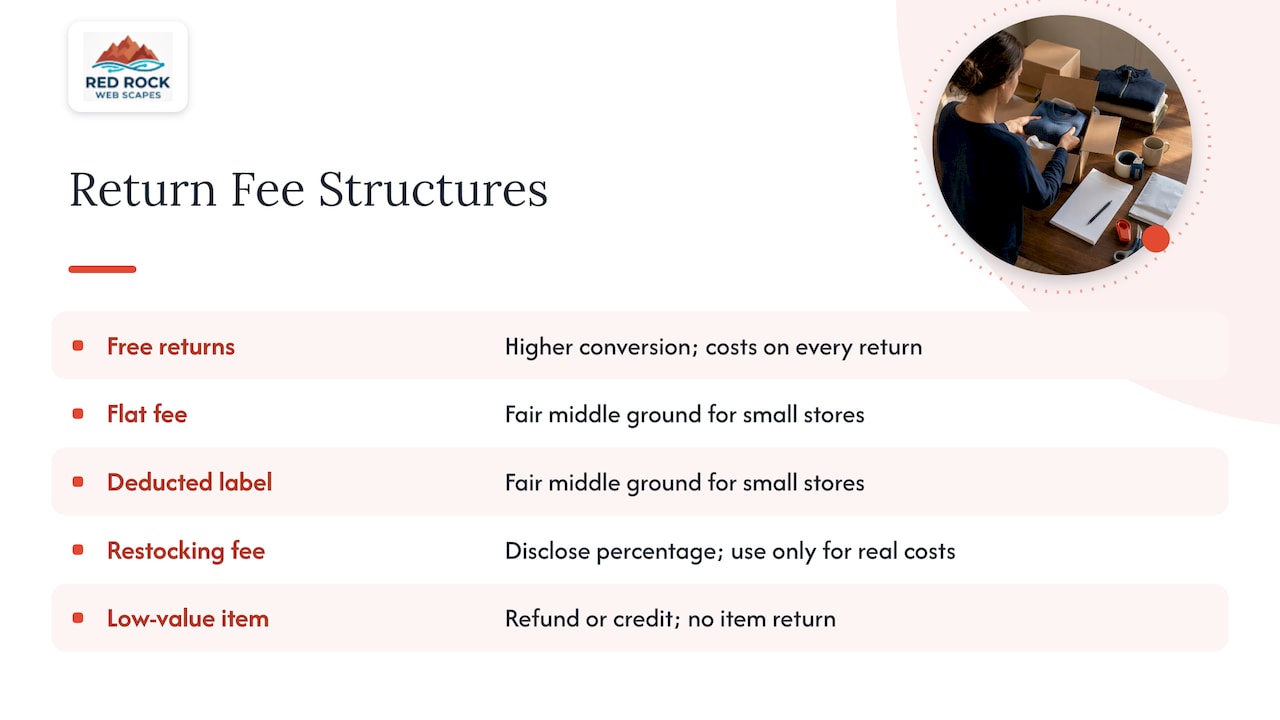
There are four common structures: free returns, a flat return fee, a return label cost deducted from the refund, and a restocking fee. Free returns win on conversion but cost you on every return. A flat or deducted label fee is a fair middle ground for most small stores. Restocking fees are the most likely to trigger complaints and legal disclosure requirements, so use them only where a real cost exists, such as opened electronics, and state the percentage clearly.
A special case is the low-value item. When return shipping would cost more than the product, ecommerce.spot suggests offering a refund or store credit without requiring the item back. Do the math on your own products: a $12 item that costs $9 to ship back and $4 to process is a loss either way, and the goodwill is worth more.
4. Refund method and timing
Default to the original payment method. Offer store credit as an option, perhaps with a small bonus, but do not force it unless you disclosed that in advance and your state allows it. Give a timeline you can keep, for example: “We issue your refund within five business days of receiving the return. Your bank may take additional days to post it.” Count the days from when you receive and inspect the item, and never promise faster than your process allows.
5. Exchanges
Decide whether an exchange is instant, handled after the return arrives, or limited to one free exchange per order. Exchanges keep the sale, so many stores make them the easiest path: wrong size, swap it, no fee.
Where the sections can differ by product type
One policy rarely fits everything you sell. Break it into short blocks when your catalog calls for it.
| Product type | Typical approach | Wording to include |
|---|---|---|
| Standard physical goods | 30-day refund or exchange | Condition, label cost, refund timing |
| Personalized or made-to-order | Final sale unless defective | State this on the product page and at checkout |
| Perishables | No returns, but replace or refund if damaged or wrong | Report within a set number of days, with photos |
| Digital downloads | No returns after download, refund if file is faulty | Explain how to report an issue |
| Defective or damaged items | Always replace or refund, store pays shipping | How to submit photos and order number |
| Low-value items | Refund without return | Threshold amount |
If you sell digital products, see how creators handle this in guidance on selling Etsy digital products while protecting profit. The core idea carries over: say clearly that downloads are non-refundable once delivered, and say what you will do if a file does not work.
Run returns as a process, not just a page
A policy only works if your team can carry it out the same way every time.
- Issue a return authorization. Zoho’s guide to handling customer returns recommends a Return Merchandise Authorization number. It ties a package to a request, leaves an audit trail and shows the return status and the reason.
- Inspect and sort. Use the same three buckets each time: resellable, customer-damaged and carrier-damaged. Carrier-damaged items get a claim with the carrier instead of a loss on your books.
- Refund quickly. Refund as soon as the item is verified. Speed is the cheapest trust-builder you have.
- Log the reason. If one product keeps coming back as “runs small” or “not as pictured,” fix the product page or the product itself.
A short returns form on your site, with order number, item, reason and photos for damage, will do most of this without software. Add tooling once volume justifies it.
Where to show the policy
A policy buried in the footer helps no one, and in states with disclosure rules it may not satisfy the law. Put it in these places:
- A footer link on every page, labeled “Returns & Exchanges.”
- A one-line summary on each product page: “Free 30-day returns” or “Final sale.”
- The cart or checkout page, before payment, with a link to the full text.
- The order confirmation email and the packing slip.
A short summary with a link to the full policy is better than a wall of text. If you are still launching, our ecommerce launch checklist covers the legal pages and FTC items alongside speed and tracking, and our guide to U.S. website privacy policies covers the sibling page every store needs. A visible, clear policy also supports the trust signals we discuss in our piece on raising small-store conversion rates.
A return policy template you can adapt
Copy this, replace the brackets and have an attorney review it for the states you sell in.
Returns & Exchanges
We want you to be happy with your order. If you are not, you can return most items within [30] days of delivery.
What can be returned: Items that are unused, in original packaging and with tags attached. Personalized items, gift cards and items marked Final Sale cannot be returned unless they arrive damaged or defective.
How to start a return: Go to [returns page link] and enter your order number and email. We will send a return authorization number and instructions within [1] business day.
Shipping and fees: [Return shipping costs $X and is deducted from your refund. / Returns are free.] If your item arrived damaged or incorrect, we cover shipping.
Refunds: We refund to your original payment method within [5] business days of receiving your return. You may choose store credit instead.
Exchanges: Need a different size or color? Tell us on the return form and we will ship the replacement when your return is scanned by the carrier.
Late or missing orders: If your order has not shipped by the date we gave you, we will contact you and offer you the choice to wait or cancel for a full refund.
Questions: Email [address] or call [number].
Our perspective: policy is a design problem
We build online stores for small businesses, and we see the same pattern. Owners treat the return policy as a legal chore, paste in text from a big retailer and forget it. Then the store launches, and the first returns arrive with no process behind them.
Our view is that a return policy is part of the store’s design. It should be short enough to read at checkout, specific enough to prevent arguments and honest about cost. A big retailer can absorb free returns on everything. A store with thin margins often cannot, and pretending otherwise leads to resentment on both sides. Better to offer a fair, clearly stated structure and keep your word.
That is why on e-commerce projects we place the policy summary on product pages and in the cart, not only in the footer, and why we think about the returns form, confirmation emails and refund steps while the store is built, not after. Policies change as you learn which products come back and why. Revisit yours quarterly.
— George
Build the policy into your store
If you are launching or rebuilding a store, we can set up the pages, checkout messaging and returns flow as part of the build. Our e-commerce packages include Brick & Mortar from 2500 USD one-off, E-Tail from 3500 USD one-off and Dropshipping from 4000 USD one-off. Our Website Launchpad program lists an e-commerce store build setup fee of 150 USD one-off, with Commerce Care at 199 USD per month for ongoing support. Not sure which fits? Talk to us and we will point you to the right starting point.
FAQ
How long should a return window be for an online store?
Thirty days from delivery is the most common baseline, and many guides suggest 30 to 60 days. Shorter windows are fine for perishable or seasonal goods if you state them clearly. Whatever you choose, count from delivery and put the number on product pages.
Am I legally required to accept returns?
There is no general federal requirement to accept returns for a change of mind. But states such as California require clear disclosure of your return terms, and the FTC requires timely shipping and prompt refunds when you cannot deliver on time. Defective goods are a separate matter, so check with a business attorney for your state.
Can I charge a restocking fee?
Often yes, but you must disclose it clearly before purchase, and some states have specific posting rules. Keep the fee tied to a real cost, state the percentage and avoid it on defective or wrongly shipped items. Fees are the most common source of complaints, so use them sparingly.
Should I refund to the original payment method or give store credit?
Default to the original payment method. Offer store credit as an optional alternative, ideally with a longer window or a small bonus. Forcing credit without prior disclosure can cause disputes and, in some states, legal trouble.
How do I write a return policy if I sell digital products?
State that downloads are non-refundable once delivered, then explain what you will do if the file is corrupted, missing or not as described. Keep the language short and place it at checkout so buyers see it before they pay.
Sources
- FTC: Internet Commerce and Mail-Order Rule
- FTC Consumer Advice: late delivery rights
- California Attorney General: Refund Policies
- CFPB: Buy Now, Pay Later refunds and disputes
- Checkout.com: optimize returns to reduce chargebacks
- ReturnLogic: return policy best practices
- ecommerce.spot
- Zoho Commerce: how to handle customer returns