If your business stores, processes, or transmits cardholder data, you must meet PCI DSS requirements. The fastest way to shrink that workload is to confirm whether your payment processing is fully outsourced and, if so, validate your SAQ A eligibility with your acquirer, since hosted checkout pages and tokenization can remove most of the burden from your plate.
Key Takeaways
Small merchants must comply with PCI DSS because any processing or transmission of cardholder data creates security obligations, which can be simplified by choosing the right SAQ and scope reduction strategies.
| Point | Details |
|---|---|
| Understand validation requirements | Call your acquirer to confirm which PCI SAQ applies based on how you process payments. |
| Reduce PCI scope early | Use hosted checkout pages, tokenization, or encryption solutions to minimize systems handling raw card data. |
| Document data flows | Map all systems and vendors involved in payment processing to identify and limit scope. |
| Leverage hosted payment options | Hosted checkout integrations keep sensitive data off your servers, easing compliance efforts. |
| We recommend Redrockwebscapes | Our approach focuses on designing e-commerce sites around scope-reducing payment integrations from the start. |
Table of Contents
- Which merchants must follow PCI DSS and who decides the validation path
- Merchant levels and the SAQs small businesses actually use
- The 12 PCI DSS requirements, translated into action
- A prioritized path to becoming PCI compliant
- Common mistakes and what drives up compliance costs
- Authoritative resources and three steps to start today
- Why we think PCI compliance is a design problem, not just a paperwork one
- A lower-scope way to build or rebuild your payment pages
- FAQ
- Sources
Which merchants must follow PCI DSS and who decides the validation path
Every business that stores, processes, or transmits cardholder data falls under PCI DSS, regardless of size. That part is not optional. What varies is validation: whether you need to formally prove compliance through a Self-Assessment Questionnaire (SAQ) or a Report on Compliance (ROC). Payment brands and your acquiring bank set those rules, not the PCI Security Standards Council itself, so your validation path depends on who processes your transactions and how much volume you run.
A few common scenarios and their likely outcomes:
- In-person point-of-sale with a validated terminal: usually qualifies for a simpler SAQ, often SAQ B or P2PE.
- E-commerce with a fully hosted checkout (the customer leaves your site to pay): typically eligible for SAQ A, the lightest e-commerce questionnaire.
- E-commerce with a merchant-hosted or embedded payment page: usually requires SAQ A-EP or higher, since your own code touches more of the transaction.
- Mail or telephone orders taken manually: often lands under SAQ B or C-VT depending on how the data is entered.
Call your acquiring bank directly to confirm which category applies to you, and keep a running list of every payment vendor and processor you use. That list becomes essential later when you document scope.
Merchant levels and the SAQs small businesses actually use
Payment brands sort merchants into levels largely based on transaction volume, with Level 1 covering the largest processors and Level 4 common for small businesses. Level 4 merchants often self-assess with an SAQ instead of hiring a Qualified Security Assessor (QSA), though your acquirer makes the final call.
The SAQ you use depends on how you accept payments:
- SAQ A: fully outsourced payment processing, customer redirected to a third-party hosted page or using an iframe that meets specific criteria.
- SAQ A-EP: e-commerce merchants whose website controls how payment data is collected, even if the actual card data goes to a third party.
- SAQ B-IP: standalone, PTS-approved payment terminals with an IP connection but no cardholder data stored electronically.
- SAQ C-VT: virtual terminal use, where staff manually key in card numbers through a browser-based system.
- SAQ D: everyone else, including merchants who store cardholder data directly, which carries the heaviest documentation load.
The PCI Security Standards Council recently clarified SAQ A eligibility alongside updated guidance tied to PCI DSS v4.0.1. That guidance addresses payment-page script protections, tied to requirements like 6.4.3 and 11.6.1, which govern how scripts loaded on checkout pages are managed and monitored. If you use an embedded third-party payment iframe, these updates affect whether you still qualify for SAQ A or need to step up to SAQ A-EP.
The 12 PCI DSS requirements, translated into action
The full standard reads like a legal document, but each requirement has a practical equivalent for a small operation.
- Install and maintain network security controls. Use a firewall on your router and any server you manage directly.
- Apply secure configurations. Change default passwords on every device and disable services you do not use.
- Protect stored account data. Avoid storing card numbers entirely; let your processor hold that data instead.
- Protect cardholder data with strong cryptography during transmission. Enforce HTTPS everywhere, with no exceptions for checkout pages.
- Protect systems from malware. Run reputable antivirus software on any machine that touches payment systems.
- Develop and maintain secure systems and software. Patch your website platform, plugins, and payment scripts regularly.
- Restrict access to system components and data by business need. Give employees access only to what their role requires.
- Identify users and authenticate access. Require unique logins and multi-factor authentication for admin panels.
- Restrict physical access to cardholder data. Lock up any paper receipts or terminals that handle card numbers.
- Log and monitor all access. Keep basic activity logs on your e-commerce platform and hosting account.
- Test security of systems and networks regularly. Schedule your required ASV scans if your SAQ calls for them.
- Support information security with organizational policies. Write a one-page policy covering who handles payment data and how.
For small e-commerce merchants, requirements 6 and 11 tend to expand scope the fastest, since third-party scripts, checkout plugins, and stored PAN data all pull more systems into view.
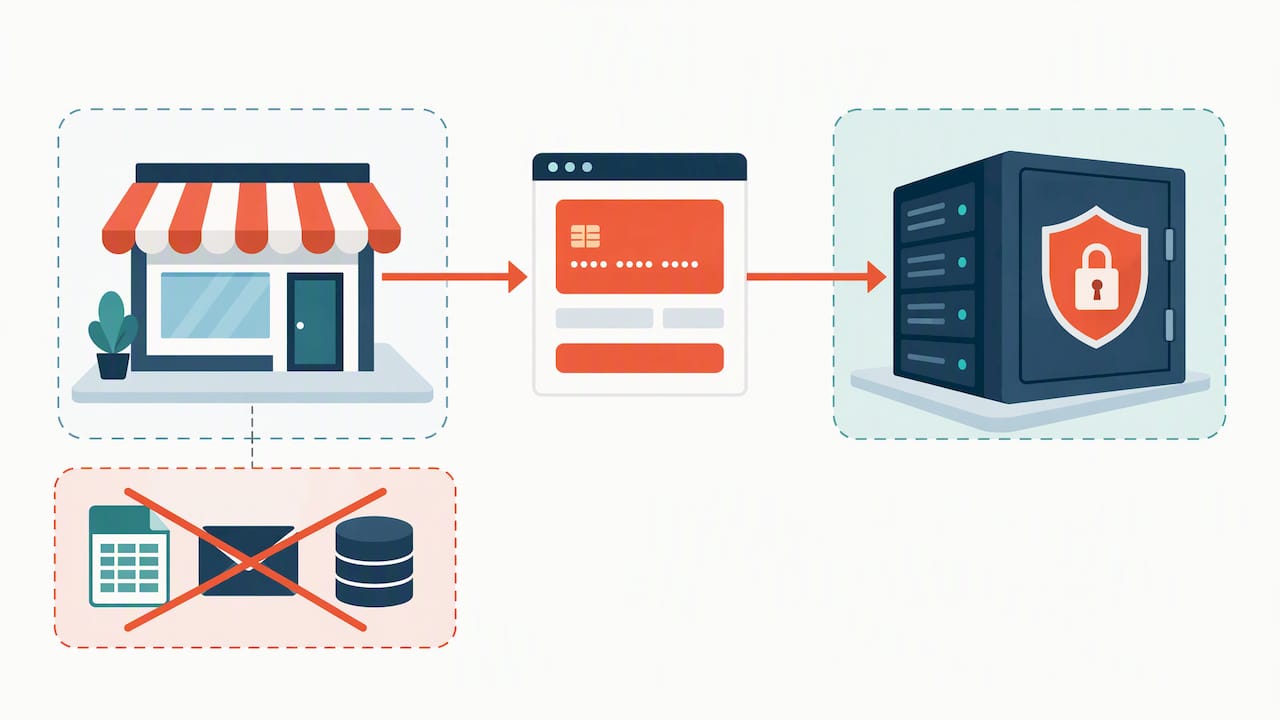
Pro Tip: Never store card numbers in spreadsheets, email, or your own database; letting your payment processor hold that data is the single fastest way to shrink your PCI scope.
A prioritized path to becoming PCI compliant
Compliance is a sequence, not a single event.
- Map your cardholder data flows. List every system, app, and vendor that touches payment information, even briefly.
- Reduce scope before anything else. Move to a hosted checkout, adopt tokenization, or use a point-to-point encryption (P2PE) solution so fewer of your own systems handle raw card data.
- Confirm your SAQ and validation path. Call your acquirer, tell them how you process payments, and ask which SAQ applies and whether an Approved Scanning Vendor (ASV) scan is required.
- Run scans and fix what they find. Quarterly ASV scans are standard for most SAQs that require them; common fixes include patching outdated software and closing open ports.
- Finalize and submit your attestation. Complete the SAQ, sign the Attestation of Compliance, and send it to your acquirer. Merchants with complex environments or SAQ D obligations often benefit from hiring a QSA rather than self-assessing.
According to the PCI Small Merchant Guide, outsourcing payment acceptance to PCI-validated providers and encrypting data in transit are among the most effective ways small merchants reduce both their risk and their validation workload. Mapping your data flows early is the step that pays off the most, since it clarifies which SAQ applies before you waste time on the wrong one.
Common mistakes and what drives up compliance costs
Most small-merchant PCI headaches trace back to a handful of recurring mistakes.
- Assuming a payment provider’s compliance covers you. Your processor being PCI-validated does not remove your own obligations, especially around how your website integrates with it.
- Leaving legacy or unscoped systems connected. An old point-of-sale terminal or forgotten integration can pull your entire network into scope.
- Running outdated plugins or themes. Unpatched e-commerce software is a common entry point for attackers and a frequent audit finding.
- Neglecting remote access controls. Shared logins or missing multi-factor authentication on admin panels are easy, costly gaps to leave open.
Cost drivers typically include developer time to fix flagged issues, QSA hours if you need a ROC, new integrations required to meet scope-reduction goals, and recurring ASV scan fees; for effective protection against such risks, learn more about scam and virus protection in Brisbane. Fixing scope-reducing measures first, like moving to a hosted checkout, usually costs less than remediating a sprawling, unscoped environment later.
Pro Tip: Before paying for any audit or scan, ask your acquirer which SAQ you actually need; many small merchants overpay for assessments scoped for a bigger environment than they have.
Authoritative resources and three steps to start today
A few official resources are worth bookmarking: the PCI SSC’s library of SAQs and guidance documents, the PCI Small Merchant Guide to Safe Payments, Visa’s Data Security Essentials evaluation tool, the public ASV and QSA registries on the PCI SSC site, and the FTC’s small business cybersecurity guidance, which complements PCI by outlining broader safeguards like risk assessments and incident response.
Three things to do this week:
- Document exactly how your business accepts payments, channel by channel.
- Call your acquirer and confirm which SAQ applies to you.
- Pick one scope-reduction move, such as switching to a hosted checkout, and start it.
If your environment involves custom payment code, multiple integrations, or stored cardholder data, that is the point to bring in a QSA rather than self-assess.
Why we think PCI compliance is a design problem, not just a paperwork one
Working on e-commerce builds has shown us that the best time to deal with PCI scope is before a site launches, not after a scan flags problems. Hosted payment pages, tokenization, and managed hosting choices made at the design stage do more to shrink scope and long-term maintenance than any amount of after-the-fact paperwork. If you are processing card data directly today, a technical review of your setup is worth the time.
— George
A lower-scope way to build or rebuild your payment pages
We build e-commerce sites around hosted checkout integrations and managed infrastructure specifically so merchants carry less PCI scope from day one. Our Website Launchpad program pairs a low-upfront site launch with ongoing Managed Core, Growth Care, or Commerce Care support, so your payment pages and hosting stay patched without you tracking it yourself.
- Hosted payment integrations keep raw card data off your own servers.
- Managed hosting and post-launch support cover the patching and monitoring that PCI requirements ask for.
Final validation and attestation stay your responsibility, so confirm your SAQ with your acquirer either way. If you want a site built with that scope reduction in mind from the start, take a look at our e-commerce services or package options.
FAQ
Does a small business need to be PCI compliant?
Yes. Any business that stores, processes, or transmits cardholder data must meet PCI DSS requirements regardless of size. Whether you must formally validate that compliance through an SAQ depends on rules set by your acquirer and the payment brands.
Can I do PCI compliance myself?
Many small merchants self-assess using the appropriate SAQ rather than hiring a Qualified Security Assessor. If your setup is simple, such as a fully outsourced hosted checkout, self-assessment is usually straightforward; more complex environments often call for outside help.
Do I need to be PCI compliant if I use a hosted payment processor?
Yes, but using a validated third-party processor with a hosted checkout page can qualify you for the simplest SAQ, SAQ A. Your processor’s own compliance does not remove your obligation to confirm your SAQ eligibility and submit an attestation.
Do I really need PCI compliance?
If you accept card payments in any form, PCI DSS applies to you; it is not optional regardless of how small your transaction volume is. Skipping validation when your acquirer requires it can risk fines or loss of your ability to process cards, so confirming your requirements directly with your acquirer is worth the call.
Sources
- Do small merchants with limited transaction volumes need comply with PCI DSS? – PCI Security Standards Council
- Important Updates Announced for Merchants Validating to Self-Assessment Questionnaire A
- Cybersecurity for small businesses – Federal Trade Commission


1 comment